Due to a ransomware attack, the wiki was reverted to a July 2022 version. . We apologize for the lack of a more recent valid backup.
Table of Contents maxLevel 4
Team
| maxLevel | 4 |
|---|
| Name | Organization | |
|---|---|---|
| Adarsh M | Huawei Technologies | adarsh.m@huawei.com |
| Bharat Saraswal | Huawei Technologies | bharat.saraswal@huawei.com |
| Gaurav Agrawal | Huawei Technologies | gaurav.agrawal@huawei.com |
| Janani B | Huawei Technologies | janani.b@huawei.com |
| Sathish Kumar M | Huawei Technologies | sathishkumar.m@huawei.com |
| Suchitra H N | Huawei Technologies | suchitra.hn@huawei.com |
| Vidyashree Rama | Huawei Technologies | vidyashree.rama@huawei.com |
| Vinod Kumar S | Huawei Technologies | vinods.kumar@huawei.com |
| Shankara | Huawei Technologies | |
| Mahesh Poojary S | Huawei Technologies | |
| Rama Subba Reddy S | Huawei Technologies | |
| Sonu Gupta | Huawei Technologies | sonu.gupta@huawei.com |
| A U surya | Huawei Technologies |
Overview
YANG is a data modeling language used to model configuration & state data. Modeling languages such as SMI (SNMP), UML, XML Schema, and others already existed. However, none of these languages were specifically targeted to the needs of configuration management. They lacked critical capabilities like being easily read and understood by human implementers, and fell short in providing mechanisms to validate models of configuration data for semantics and syntax.
YANG Utils tools are the basic building block to achieve the final goal of abstracting the language based Syntax/Semantics processing by APPs.
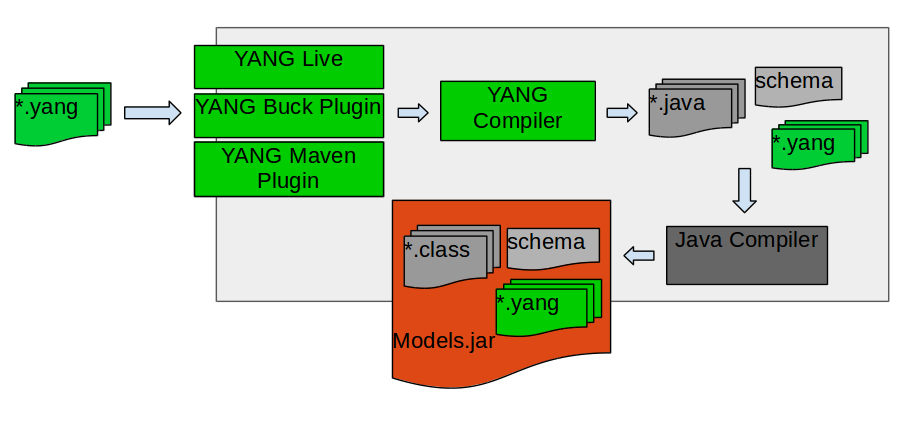
The YANG modeled interfaces need to be implemented by corresponding application component. There are 2 parts in implementing the interface:
- syntaxSyntax/semantics processing of the request/response being exchanged.
- business Business logic to compute the request.
We intend to abstract the applications from syntactic processing of information encoding with external world.We intend to provide a framework in which the applications only need to implement the business logic and seamlessly support any interface language like REST, NETCONF etc.
Steps to use YANG
...
tools
Yang Buck Plugin :
Step 1
...
: Create a test app and add
...
yang dependency as shown below.
| Code Block |
|---|
<build> COMPILE_DEPS = <plugins>[ <plugin>'//lib:CORE_DEPS', '//lib:onos-yang-model', ] yang_osgi_jar( deps <groupId>org.onosproject</groupId>= COMPILE_DEPS, name <artifactId>yangutils-maven-plugin</artifactId>= 'onos-apps-l3vpn-yangmodel', srcs = glob(['src/main/**/*.yang']), visibility = [ 'PUBLIC' ], ) |
Step 2: Create a folder structure as “src/main/yang” in the test app folder and place your YANG files in it.
Step 3 : Build using buck build onos command. Generated java code will be placed in default directory or in desired destination folder configured by user.
Yang Maven Plugin :
Step1 : Create a test app and add YANG tools maven plugin to pom file’s build section
| Code Block |
|---|
<build> <plugins> <plugin> <groupId>org.onosproject</groupId> <artifactId>onos-yang-maven-plugin</artifactId> <version>1.9</version> <version>1.0.0-SNAPSHOT</version> <executions> <execution> <configuration><configuration> <classFileDir>src/main/java</classFileDir> </configuration> <goals> <goal>yang2java</goal> </goals> </execution> </executions> </plugin> </plugins> </build> |
Step 2 : Add dependency to pom file’s dependency section
| Code Block |
|---|
<dependencies>
    <dependency>
        <groupId>org.onosproject</groupId>
        <artifactId>yangutils-maven-plugin</artifactId>
        <version>1.0.0-SNAPSHOT</version>
    </dependency>
    <dependency>
        <groupId>org.onosproject</groupId>
        <artifactId>onos-api</artifactId>
    </dependency>
    <dependency>
        <groupId>org.apache.felix</groupId>
        <artifactId>org.apache.felix.scr.annotations</artifactId>
    </dependency>
</dependencies> |
only if your yang file contains notification in it. You need to add dependencies for "onos-api".
Step 3 : Step 3 : Plugin configuration supported in YANG utilstools
Create a folder structure as “src/main/yang” in the test app folder and place your YANG files in it.
If incase In case user want to give desired path for source YANG files and generated java files, the following configuration can be appended to the above pom.xml file.
Code Block <configuration><yangFilesDir>/opt/src/yang/</<yangFilesDir>DesiredYangFilesPath</yangFilesDir>
<genFilesDir>/opt/src/java/</genFilesDir><classFileDir>DesiredGeneratedJavaFilesPath</classFileDir> </configuration>
In YANG, identifier has the support of having “.”, ”-”, “_”. But, in java, we cannot use these characters in class name or attribute name. Hence, by default, these characters will be removed and the successive character will be capitalized for making it camel case. Similarly, in YANG, we can have java keywords and starting with digits, in namespace and identifiers. But, in java, we cannot use it in class name or attribute name or package. Hence, by default, a prefix "yangAutoPrefix" will be added to the identifier name.Here users are given options to change this default behaviour.“.”, ”-”, “_” in identifier name can be replaced by the values given inside the configuration of pom.xml and will be used in java, respectively. Similarly, the prefix value can also be provided in configuration of pom.xml and that will be used as prefix for identifiers.(refer identifier for more details)
Code Block <configuration> <replacementForPeriod>dot</replacementForPeriod> <replacementForHyphen>hyphen</replacementForHyphen> <replacementForUnderscore>underscore</replacementForUnderscore> <prefixForIdentifier>prefix</prefixForIdentifier> </configuration>yang-._constuct-generation will be mapped as yangHyphenDotUnderscoreConstuctHyphenGeneration
const will be mapped as prefixConst
Default package/folder structure for generated code will be constructed from the namespace of the YANG file and if user wants to generated code with specific folder structure/package he can configure it , using below configurations.
Code Block <configuration> <defaultPackage>org.onosproject.sfc</defaultPackage> </configuration>In above example code will be generated in org.onosproject.sfc package.
As Grouping construct being an special case in YANG. we are giving user a flexibility to choose whether to generate code for grouping node or not. So if user does not wants to generate code he should set the configurations as false. By default code will be generated.
Code Block <configuration> <groupingCodeGenFlag>true</groupingCodeGenFlag> </configuration>In case of RPC construct we have given flexibility for controlling the generation of code for input and output sub statements in a special cases where Input or output contains only one leaf/leaf-list/Yang construct. In such case user can configure whether he wants to generate code for input or output. By default code will be generated and in case input or output contains multiple leaf/leaf-list/Yang constructs code will be generated even the configuration is false.
Code Block <configuration> <rpcSubStatementCodeGenFlag>true</rpcSubStatementCodeGenFlag> </configuration>
Step 4 : Execution of application
Build using mvn clean install/ mvn install. Generated java code will be placed in default directory or in desired destination folder configured by user.
Note : Code generated is as per ONOS coding guidelines.
YANG utils constructs support/plan
Step 4 : Execution of application
Build using mvn clean install/ mvn install. Generated java code will be placed in default directory or in desired destination folder configured by user.
| Info | ||
|---|---|---|
| ||
Note:
|
YANG tools constructs support/plan
Goldeneye
Enhancement in Hummingbird
Goldeneye
Enhancement in Humminbird
Goldeneye
Enhancement in Hummingbird
Goldeneye
Enhancement in Hummingbird
Goldeneye
Enhancement in Hummingbird
| YANG Construct | Supported/Planned version |
|---|---|
| anyxml | Not planned |
| argument | Hummingbird(partial support) |
| augment | Goldeneye |
| uses-augment | Loon |
| base | Hummingbird |
| belongs-to | Goldeneye |
| bit | Hummingbird |
| case | Goldeneye |
| choice | Goldeneye |
| config | Falcon |
| contact | Goldeneye Enhancement in Hummingbird |
| container | Falcon |
| default | Goldeneye Enhancement in Humminbird |
| description | Goldeneye Enhancement in Hummingbird |
| deviate | Not planned |
| deviation | Not planned |
| enum | Goldeneye |
| error-app-tag | Hummingbird |
| error-message | Hummingbird |
| extension | Hummingbird(partial support) |
| feature | Hummingbird |
| fraction-digits | Hummingbird |
| grouping | Goldeneye |
| identity | Hummingbird |
| if-feature | Hummingbird |
| import | Goldeneye Enhancement in Hummingbird |
| include | Goldeneye Enhancement in Hummingbird |
| input | Goldeneye |
| key | Goldeneye |
| leaf | Falcon |
| leaf-list | Falcon |
| length | Goldeneye |
| list | Falcon |
| mandatory | Falcon |
| max-elements | Goldeneye |
| min-elements | Goldeneye |
| module |
| Falcon | |
| must | Hummingbird |
| namespace | Goldeneye |
| notification | Goldeneye |
| ordered-by | Not planned |
| organization | Goldeneye Enhancement in Hummingbird |
| output | Goldeneye |
| path | Hummingbird |
| pattern | Goldeneye |
| position | Goldeneye |
| prefix | Goldeneye |
| presence | Goldeneye |
| range | Goldeneye |
| reference | Goldeneye Enhancement in Hummingbird |
| refine | Not planned |
| require-instance |
| Hummingbird | |
| revision | Goldeneye Enhancement in Hummingbird |
| revision-date | Goldeneye |
| rpc | Goldeneye |
| status | Goldeneye Enhancement in Hummingbird |
| submodule | Goldeneye |
| type | Goldeneye |
| typedef | Goldeneye |
| unique |
| Kingfisher | |
| unknown | Kingfisher |
| units | Goldeneye |
| uses | Goldeneye Enhancement in Hummingbird |
| value | Goldeneye |
| when | Hummingbird |
| yang-version | Goldeneye |
| yin-element | Not Planned |
Built-in YANG data types support/plan
| Binary | Goldeneye Enhancement in Hummingbird |
| Bits | Goldeneye Enhancement in Hummingbird |
| boolean | Goldeneye |
| decimal64 | Goldeneye Enhancement in Hummingbird |
| empty | Goldeneye |
| enumeration | Goldeneye |
| identityref | Hummingbird |
| instance-identifier | Hummingbird |
| int8 | Goldeneye |
| int16 | Goldeneye |
| int32 | Goldeneye |
| int64 | Goldeneye |
| leafref | Hummingbird |
| string | Falcon |
| uint8 | Goldeneye |
| uint16 | Goldeneye |
| uint32 | Goldeneye |
| uint64 | Goldeneye |
| union | Goldeneye |
Generated JAVA Details
Common behavior
Identifier
The identifier name of yang YANG constructs are taken, and are used in java by converting it to lower camel case. Identifier names are allowed to have three special characters such as “-”, ”_”, “.”. Whereas, in java, we cannot use these special characters. These characters will be removed during conversion. Conversion takes place by following the below rules of lower camel case.
The first letter of the identifier will be a small letter. If the three special characters occur alone or in group, they will be removed and the consecutive letter will be capitalized.
name-conversion will be mapped as nameConversion
yang-._constuct-generation will be mapped as yangConstuctGeneration
When identifier name has a special character followed by a number, the following letter from the digits will be capitalized.
yang_123construct will be mapped to yang123Construct
In java file, class name or attribute name cannot have java keyword or start with digits. During the conversion into java, we add prefix to the identifier “yangAutoPrefix”, by default.
_123date will be mapped to yangAutoPrefix123Date
const will be mapped to yangAutoPrefixConst
As per camelcase conversion rules, no two consecutive letters will have capitalization and the last letter will also not be capitalized.
ca- ca-l.e_nder will be mapped to caLeNder
tric- tric-._k will be mapped to trick
If users input has capital case, the following will be the conversion methods.
TESTNAME will be mapped to testname
TESTTEST-NAME will be mapped to testName
TestName TestName will be mapped to testName
TEST3NAME will be mapped to test3Name
- TESTNAME
...
| Info | ||
|---|---|---|
|
...
If an identifier for a construct contains java keywords, then it name will be prefixed with "yangAutoPrefix" in generated code. |
Namespace
The namespace is a mandatory statement in the module. We define namespace for URL/URI and for folder structure of generated java code. Here in ONOS YANG plugin, namespace forms a folder structure which in turn will be the package name in java.
The package will have “org.onosproject.yang.gen.v1.” by default in it. The namespace will be added to the above and the folder structure will also be formed respectively. This becomes the parent package.
When a node occurs in yang, a new package will be generated under the parent package. The new package name is the node name and class for that node will be placed under this newly created package. The conversion from yang namespace to the The conversion from YANG namespace to the java package will take place as below.
The complete namespace will be changed to lowercase letters. When special characters or a group of special characters are found, it replaces those characters by dot.
"http://acme.example.com/system" will be mapped
as as org.onosproject.yang.gen.v1.http.acme.example.com.system.rev20160427
In java the package cannot have folder name which begins with digits or java keyword. Incase if found in YANG file these will be converted by adding prefix “yangautoprefix”.
http://acme.123example.com/try" will be mapped
as as org.onosproject.yang.gen.v1.http.acme.yangautoprefix123example.com.yangautoprefixtry.rev20160427
- At the end of the package the revision in module will be added by the string rev<yyyymmdd>.If the revision does not exist in the
yang - YANG file current date will be appended to the package.
Javadocs
Currently Java doc will be generated as per ONOS javadoc guidelines.
Note: Here in wiki for the given examples for each YANG construct we have removed generated javadocs for documentation purpose. Code will contain all the default javadoc which we are providing in golden-eye release. Javadocs support will be enhanced in hummingbird release.
YANG statements
Module
Overview
The primary unit of YANG is module. The module statement groups all the statements that belong to module together. The module statement argument is name of the module followed by sub-statements.
JAVA mapping
Module statement is mapped to
- Service interface
It includes:
a) java methods corresponding to the YANG RPC (Refer RPC section for more details)
b) If module contains notification, generated service interface will extend listener service (refer notification for more details) - Manager class
It includes:
a ) Activate/Deactivate methods
b) If module contains child data nodes, getters and setters for those nodes will be generated for app developers to implement.
c)If module contains notification, generated manager class will extend ListenerRegistry(refer notification for more details) .
The manager class implements the service interface. The name of service interface and manager class is <module_name>Service.java and <module_name>Manager.java.
Example
When a node appears, with child node in it, a new package will be generated under the parent package, for that node. The new package is, parent package appended with the node name. The class for that node will be placed under this newly created package.
Example
| Code Block | ||
|---|---|---|
| ||
File : acme-system.yang
module acme-system {
     namespace "http://acme.example.com/system";
     prefix "acme";
organization "ACME Inc." | ||
| Code Block | ||
| ||
File : network.yang module network { yang-version 1; namespace "urn:TBD:params:xml:ns:yang:nodescontact "joe@acme.example.com"; prefix nd;description organization "TBD"; "The module for contact entities implementing the "WILL-BE-DEFINED-LATERACME system."; revision 2007-06-09 description{ "This module definesdescription a common base model for a collection"Initial revision."; } container system { of nodes in a network. Node definitions s arecontainer furtherlogin used{ in network topologies and inventories."; revision 2014-03-09leaf message { description "Initial revision."type string; reference "draft-clemm-i2rs-yang-network-topo-04"; } description list networklist { key "network-id"; leaf network-id { "Message given at start of login session"; type string; } leaf server-provided {} } type boolean;. . config false; } } …. } |
| Code Block | ||
|---|---|---|
| ||
File : NetworkServiceSystem.java package org.onosproject.yang.gen.v1.urnhttp.tbdacme.paramsexample.xmlcom.nssystem.yangrev20070609.nodes.rev20140309acmesystem; import java.util.List; import org.onosproject.yang.gen.v1.urnhttp.tbdacme.paramsexample.xmlcom.nssystem.yangrev20070609.nodesacmesystem.rev20140309.network.Networklist; system.Login; /** * Abstraction of an entity which represents the functionality of system. */ public interface NetworkServiceSystem { /** * Returns the attribute login. * * @return login List<Networklist> getNetworklist(); value of login */ voidLogin setNetworklistlogin(List<Networklist> networklist); } File : NetworkManager.java package org.onosproject.yang.gen.v1.urn.tbd.params.xml.ns.yang.nodes.rev20140309; import java.util.List; import org.apache.felix.scr.annotations.Activate; import org.apache.felix.scr.annotations.Component; import org.apache.felix.scr.annotations.Deactivate; import org.apache.felix.scr.annotations.Service; import org.onosproject.yang.gen.v1.urn.tbd.params.xml.ns.yang.nodes.rev20140309.network.Networklist; import org.slf4j.Logger; import static org.slf4j.LoggerFactory.getLogger; @Component (immediate = true) @Service public class NetworkManager implements NetworkService { private final Logger log = getLogger(getClass()); /** * Sets the attribute login. * * @param login value of login */ void login(Login login); } |
Javadocs
Currently Java doc will be generated as per ONOS javadoc guidelines.
YANG statements
Module
Overview
The primary unit of YANG is module. The module statement groups all the statements that belong to module together. The module statement argument is name of the module followed by sub-statements.
JAVA mapping
Module statement is mapped to
Service interface
It includes:
a) java methods corresponding to the YANG RPC (Refer RPC section for more details)
b) If module contains notification, generated service interface will extend listener service (refer notification for more details).The name of service interface is <module_name>Service.java .
c) If module contains augment the get and setter for augmented module will be generated.Info Service file will be generated only if RPC/Notification is present.
- Interface and implementation class (Note: for module implementation class will have name xxxxOpParam.java)
Example
| Code Block | ||
|---|---|---|
| ||
File : network.yang module network { yang-version 1; namespace "urn:TBD:params:xml:ns:yang:nodes"; prefix nd; organization "TBD"; contact "WILL-BE-DEFINED-LATER"; description "This module defines a common base model for a collection of nodes in a network. Node definitions s are further used @Activate public void activate() { //TODO: YANG utils generated code log.info("Started"); } @Deactivate public void deactivate() { //TODO: YANG utils generated code log.info("Stopped"); } @Override public List<Networklist> getNetworklist() { //TODO: YANG utils generated code in network topologies returnand null;inventories."; } revision 2014-03-09 { @Override public void setNetworklist(List<Networklist> networklist)description { //TODO: YANG utils generated code } } |
Sub Module
Overview
The “submodule” groups all the statements that belongs to the submodule together. The "submodule" statement's argument is the name of the submodule, followed by a block of sub statements.
JAVA mapping
Submodule mapping to java is same as module and files with be generated in module’s namespace.
Example
| Code Block | ||
|---|---|---|
| ||
File : acme-system.yang module acme-system { namespace "http://yang-central.org/ns/example/acme"; prefix acme; include "acme-types";"Initial revision."; reference "draft-clemm-i2rs-yang-network-topo-04"; } list networklist { key "network-id"; leaf network-id { type string; } } File : acme-types.yang submodule acme-types { } yang-version 1; leaf belongsserver-to "acme-system" {provided { prefix "acme"; type boolean; } leaf access-timeout {config false; } type uint32; } leaf retries { rpc rpc-test { input { container cont { leaf lf { type uint8string; } } } } } |
| Code Block | ||
|---|---|---|
| ||
File : AcmeSystemManagerNetworkService.java package org.onosproject.yang.gen.v1.httpurn.yangtbd.centralparams.orgxml.ns.exampleyang.acmenodes.rev20160526rev20140309; import org.apacheonosproject.felixyang.scrgen.annotations.Activate; import org.apache.felix.scr.annotations.Component; import org.apache.felix.scr.annotations.Deactivate; import org.apache.felix.scr.annotations.Service; import org.slf4j.Logger; import static org.slf4j.LoggerFactory.getLogger; @Component (immediate = true) @Service public class AcmeSystemManager implements AcmeSystemService { private final Logger log = getLogger(getClass()); @Activate public void activate() { //TODO: YANG utils generated codev1.urn.tbd.params.xml.ns.yang.nodes.rev20140309.network.rpctest.RpcTestInput; /** * Abstraction of an entity which represents the functionality of network. */ public interface NetworkService { /** * Service interface of log.info("Started");rpcTest. } * @Deactivate public void* deactivate() { //TODO: YANG utils generated code@param inputVar input of service interface rpcTest */ void log.info("Stopped"); rpcTest(RpcTestInput inputVar); } File : Network.java package @Override public String getId() { //TODO: YANG utils generated code return null; } @Override public void setId(String id) { //TODO: YANG utils generated code } } File : AcmeSystemService.java package org.onosproject.yang.gen.v1.http.yang.central.org.ns.example.acme.rev20160526; public interface AcmeSystemService { String getId(); void setId(String id); } File : AcmeTypesManager.java package org.onosproject.yang.gen.v1.http.yang.central.org.ns.example.acme.rev20160526; import org.apache.felix.scr.annotations.Activate; import org.apache.felix.scr.annotations.Component; import org.apache.felix.scr.annotations.Deactivate; import org.apache.felix.scr.annotations.Service; import org.slf4j.Logger; import static org.slf4j.LoggerFactory.getLogger; @Component (immediate = true) @Service public class AcmeTypesManager implements AcmeTypesService { private final Logger log = getLogger(getClass()); @Activate public void activate() { //TODO: YANG utils generated code log.info("Started"); } @Deactivate public void deactivate() { //TODO: YANG utils generated code log.info("Stopped"); } @Override public long getAccessTimeout() { //TODO: YANG utils generated code return 0; } @Override public short getRetries() { //TODO: YANG utils generated code org.onosproject.yang.gen.v1.urn.tbd.params.xml.ns.yang.nodes.rev20140309; import java.util.List; import org.onosproject.yang.gen.v1.urn.tbd.params.xml.ns.yang.nodes.rev20140309.network.Networklist; /** * Abstraction of an entity which represents the functionality of network. */ public interface Network { /** * Returns the attribute networklist. * * @return networklist list of networklist */ List<Networklist> networklist(); /** * Sets the attribute networklist. * * @param networklist list of networklist */ void networklist(List<Networklist> networklist); /** * Adds to the list of networklist. * * @param addTo value of networklist */ void addToNetworklist(Networklist addTo); } File: NetworkOpParam.java package org.onosproject.yang.gen.v1.urn.tbd.params.xml.ns.yang.nodes.rev20140309; import com.google.common.base.MoreObjects; import java.util.ArrayList; import java.util.List; import java.util.Map; import java.util.Objects; import org.onosproject.yang.gen.v1.urn.tbd.params.xml.ns.yang.nodes.rev20140309.network.Networklist; import org.onosproject.yang.model.InnerModelObject; /** * Represents the implementation of network. * * <p> * valueLeafFlags identify the leafs whose value are explicitly set * Applicable in protocol edit and query operation. * </p> */ public class NetworkOpParam extends InnerModelObject implements Network { protected List<Networklist> networklist; @Override public List<Networklist> networklist() { return 0networklist; } @Override public void setAccessTimeoutnetworklist(longList<Networklist> accessTimeoutnetworklist) { //TODO: YANG utils generated codethis.networklist = networklist; } @Override public void setRetriesaddToNetworklist(shortNetworklist retriesaddTo) { if //TODO: YANG utils generated code(networklist == null) { } } File : AcmeTypesService.java package org.onosproject.yang.gen.v1.http.yang.central.org.ns.example.acme.rev20160526; public interface AcmeTypesService { networklist = longnew getAccessTimeoutArrayList<>(); } short getRetries( networklist.add(addTo); void setAccessTimeout(long accessTimeout);} void setRetries(short retries); } |
Prefix
Overview
Prefix is used to define prefix associated with module. It is used as a hint to other module developers when they import our module.
JAVA mapping
There is no java mapping for prefix statement.
Example
| Code Block |
|---|
module dhcp {
  namespace "http://yang-central.org/ns/example/dhcp";
  prefix dhcp;

 import ietf-yang-types { prefix yang; }
 import ietf-inet-types { prefix inet; }
} |
Note the prefixes above. In order to refer to the yang-module from now on, we use the prefix, e.g. the statement:
type yang:date-and-time;
refers to the date-and-time type defined in the yang-types module.
We use the prefix defined in the module itself, e.g. in the yang-types module, the prefix is defined as yang. You can use which prefix you want in your import, as long as it is unique within the module, but by using the prefix from the module, your module will be easier to read for others.
Import
Overview
A module can import definitions from other module or submodule by using import statement. It takes an argument, the name of the module or submodule followed by sub statements prefix and revision statement. Multiple import statements may be specified to import from different modules. Prefix statement inside import is mandatory and its scope is within the imported module or sub-module.
JAVA mapping
When imported YANG file is used in any of the nodes in current YANG file, then Java code will genereted for imported YANG file. If it is imported YANG file is not used in any of the node in current YANG file then Java code for imported file will not be genereted.
Example
| Code Block | ||
|---|---|---|
| ||
File : flow-classifier.yang module flow-classifier { yang-version 1; namespace "sfc.flowclassifier"; prefix "flow-classifier"; import "ietf-yang-types" { prefix "yang"; } organization "ON-LAB"; description "This submodule defines for flow classifier."; revision "2016-05-24" {@Override public int hashCode() { return Objects.hash(networklist); } @Override public boolean equals(Object obj) { if (this == obj) { return true; } if (obj instanceof NetworkOpParam) { NetworkOpParam other = (NetworkOpParam) obj; return Objects.equals(networklist, other.networklist); } return false; } @Override public String toString() { return MoreObjects.toStringHelper(getClass()) .omitNullValues() .add("networklist", networklist) .toString(); } /** * Creates an instance of networkOpParam. */ public NetworkOpParam() { } @Override public void addAugmentation(InnerModelObject obj) { } @Override public void removeAugmentation(InnerModelObject obj) { } @Override public Map<Class<? extends InnerModelObject>, InnerModelObject> augmentations() { descriptionreturn "Initial revision.";null; } @Override leaf id {public <T extends InnerModelObject> T augmentation(Class<T> c) { typereturn yang:uuidnull; } } } |
Sub Module
Overview
The “submodule” groups all the statements that belongs to the submodule together. The "submodule" statement's argument is the name of the submodule, followed by a block of sub statements.
JAVA mapping
Submodule mapping to java is same as module and files with be generated in module’s namespace.
Example
| Code Block | ||
|---|---|---|
| ||
File : ietfacme-yang-typessystem.yang module ietfacme-yang-typessystem { namespace "urn:ietf:params:xml:ns:yang:ietf-yang-typeshttp://yang-central.org/ns/example/acme"; prefix "yangprefix acme; include "acme-types"; container organizationaccess { "IETF NETMOD (NETCONFleaf Dataid Modeling{ Language) Working Group"; contact type uint32; "WG Web: <http://tools.ietf.org/wg/netmod/> } WG List: <mailto:netmod@ietf.org> WG Chair: David Kessens } } File : acme-types.yang submodule acme-types { yang-version 1; belongs-to <mailto:david.kessens@nsn.com> "acme-system" { WG Chair: Juergen Schoenwaelderprefix "acme"; } container <mailto:j.schoenwaelder@jacobs-university.de> access { Editor: leaf Juergen Schoenwaelderaccess-timeout { <mailto:j.schoenwaelder@jacobs-university.de>"; type uint32; description } "This module contains a collection ofleaf generallyretries useful derived{ YANG data types. type uint8; Copyright (c) 2013 IETF Trust and} the persons identified } } |
| Info |
|---|
Code generation will be same as module. |
Prefix
Overview
Prefix is used to define prefix associated with module. It is used as a hint to other module developers when they import our module.
JAVA mapping
There is no java mapping for prefix statement.
Example
| Code Block |
|---|
module dhcp {
  namespace "http://yang-central.org/ns/example/dhcp";
  prefix dhcp;

 import ietf-yang-types { prefix yang; }
 import ietf-inet-types { prefix inet; }
} |
Note the prefixes above. In order to refer to the yang-module from now on, we use the prefix, e.g. the statement:
type yang:date-and-time;
refers to the date-and-time type defined in the yang-types module.
We use the prefix defined in the module itself, e.g. in the yang-types module, the prefix is defined as yang. You can use which prefix you want in your import, as long as it is unique within the module, but by using the prefix from the module, your module will be easier to read for others.
Import
Overview
A module can import definitions from other module or submodule by using import statement. It takes an argument, the name of the module or submodule followed by sub statements prefix and revision statement. Multiple import statements may be specified to import from different modules. Prefix statement inside import is mandatory and its scope is within the imported module or sub-module.
JAVA mapping
When imported YANG file is used in any of the nodes in current YANG file, then Java code will genereted for imported YANG file. If it is imported YANG file is not used in any of the node in current YANG file then Java code for imported file will not be genereted.
Example
| Code Block | ||
|---|---|---|
| ||
File : flow-classifier.yang module flow-classifier { yang-version 1; namespace "sfc.flowclassifier"; prefix "flow-classifier"; import "ietf-yang-types" { prefix "yang"; } organization "ON-LAB"; description "This submodule defines for flow classifier."; revision "2016-05-24" {as authors of the code. All rights reserved. Redistribution and use in source and binary forms, with or without modification, is permitted pursuant to, and subject to the license terms contained in, the Simplified BSD License set forth in Section 4.c of the IETF Trust's Legal Provisions Relating to IETF Documents (http://trustee.ietf.org/license-info). This version of this YANG module is part of RFC 6991; see the RFC itself for full legal notices."; revision 2013-07-15 { description "This revision adds the following new data types: - yang-identifier - hex-string - uuid description - dotted-quad"Initial revision."; } reference leaf id { "RFC 6991: Common YANG Data Types"type yang:uuid; } } File : revision 2010-09-24ietf-yang-types.yang module ietf-yang-types { descriptionnamespace "urn:ietf:params:xml:ns:yang:ietf-yang-types"; prefix "Initial revision."yang"; referenceorganization "IETF NETMOD "RFC 6021: Common YANG Data Types";(NETCONF Data Modeling Language) Working Group"; } contact typedef uuid { type string {"WG Web: <http://tools.ietf.org/wg/netmod/> WG List: pattern '[0-9a-fA-F]{8}-[0-9a-fA-F]{4}-[0-9a-fA-F]{4}-' <mailto:netmod@ietf.org> WG Chair: David Kessens + '[0-9a-fA-F]{4}-[0-9a-fA-F]{12}'; } <mailto:david.kessens@nsn.com> WG Chair: Juergen descriptionSchoenwaelder "A Universally Unique IDentifier in the string representation <mailto:j.schoenwaelder@jacobs-university.de> Editor: defined Juergen inSchoenwaelder RFC 4122. The canonical representation uses lowercase characters. <mailto:j.schoenwaelder@jacobs-university.de>"; description The following is"This anmodule examplecontains ofa acollection UUIDof ingenerally stringuseful representation:derived YANG f81d4fae-7dec-11d0-a765-00a0c91e6bf6data types. Copyright "; reference(c) 2013 IETF Trust and the persons identified as authors "RFCof 4122:the Acode. Universally UniqueAll IDentifier (UUID) URN rights reserved. Redistribution and use in source and binary forms, with or Namespace"; without } } |
Include
Overview
A module uses a include statement to include sub-module that belongs to module. The argument is the name of sub-module. Modules are only allowed to include sub-module that belongs to module, as defined by belongs-to statement. When a module includes a submodule, it incorporates the contents of the submodule into the node hierarchy of the module.
JAVA mapping
There is no java mapping for include statement.
Example
Please refer submodule example
Organization
Overview
The "organization" statement defines the party responsible for this module. The argument is a string that is used to specify a textual description of the organization(s) under whose auspices this module was developed.
JAVA mapping
Organization will be used as javadoc in generated java code in Hummingbird release version. Currently it is not used in generated java code.
Example
Please refer module example section
Contact
Overview
The "contact" statement provides contact information for the module. The argument is a string that is used to specify contact information for the person or persons to whom technical queries concerning this module should be sent, such as their name, postal address, telephone number, and electronic mail address.
JAVA mapping
Contact information will be used as javadoc in generated java code in Hummingbird release version. Currently it is not used in generated java code.
Example
Please refer module example section
Belongs to
Overview
The "belongs-to" statement specifies the module to which the submodule belongs. The argument is an identifier that is the name of the module. A submodule must only be included by the module to which it belongs, or by another submodule that belongs to that module.
JAVA mapping
No java mapping for belongs to statement in generated code.
Example
Please refer submodule example section.
Leaf
Overview
A leaf is an atomic element in YANG. It has value, but does not have child. It is used for defining the scalar variable of a built-in type or a derived type.
Java mapping
In java leaf is converted to define variable with its respective java built-in type or derived type.
Example
| Code Block | ||
|---|---|---|
| ||
File : acme-system.yang module acme-system { namespace "http://acme.example.com/system"; prefix "acme"; organization "ACME Inc.modification, is permitted pursuant to, and subject to the license terms contained in, the Simplified BSD License set forth in Section 4.c of the IETF Trust's Legal Provisions Relating to IETF Documents (http://trustee.ietf.org/license-info). This version of this YANG module is part of RFC 6991; see the RFC itself for full legal notices."; revision 2013-07-15 { description "This revision adds the following new data types: - yang-identifier - hex-string - uuid - dotted-quad"; reference "RFC 6991: Common YANG Data Types"; contact "joe@acme.example.com"; } descriptionrevision 2010-09-24 { description "The module for entities implementing the ACME"Initial systemrevision."; revision 2007-06-09 {reference description "Initial revision."RFC 6021: Common YANG Data Types"; } containertypedef systemuuid { type string { leaf host-name { pattern '[0-9a-fA-F]{8}-[0-9a-fA-F]{4}-[0-9a-fA-F]{4}-' type string+ '[0-9a-fA-F]{4}-[0-9a-fA-F]{12}'; } description "Hostname for this system"; "A Universally Unique IDentifier in the string }representation } . defined in RFC 4122. The . } |
| Code Block | ||
|---|---|---|
| ||
File: System.java public interface System extends AugmentationHolder { canonical representation uses String hostName();lowercase characters. interface SystemBuilder { The following is an example String hostName(); of a UUID in string representation: SystemBuilder hostName(String hostName); f81d4fae-7dec-11d0-a765-00a0c91e6bf6 System build()"; } } File : SystemBuilder.javareference public class SystemBuilder implements System.SystemBuilder { "RFC private4122: String hostName; @Override A Universally Unique IDentifier (UUID) URN public String hostName() { return hostNameNamespace"; } } |
| Code Block | ||
|---|---|---|
| ||
File : Uuid.java package @Override public SystemBuilder hostName(String hostName)org.onosproject.yang.gen.v1.urn.ietf.params.xml.ns.yang.ietf.yang.types.rev20100924.ietfyangtypes; import java.util.Objects; import com.google.common.base.MoreObjects; public final class Uuid { private this.hostName = hostNameString string; private return this;Uuid() { } . public Uuid(String value) .{ . publicthis.string final= classvalue; SystemImpl implements System {} public static Uuid of(String value) private{ String hostName; return new @OverrideUuid(value); } public String hostNamestring() { return string; return hostName;} @Override } public int hashCode() { . . return Objects.hash(string); } } |
Leaf-list
Overview
A leaf-list is also used for defining scalar variable, like leaf, but in an array of a particular type. The type of the variable can be either built-in type or a derived type.
Java mapping
In java leaf-list is stored in List, with respect to, java built-in type or derived type.
Example
| Code Block | ||
|---|---|---|
| ||
File : acme-system.yang module acme-system { namespace "http://acme.example.com/system"; @Override public boolean equals(Object obj) { prefix "acme"; if (this == obj) { organization "ACME Inc."; contact "joe@acme.example.com"return true; description } "The module for entitiesif implementing(obj theinstanceof ACME system.";Uuid) { revision 2007-06-09 { Uuid other = description "Initial revision."(Uuid) obj; } container system {return leaf-list domain-search { Objects.equals(string, other.string); } return type stringfalse; } @Override public String toString() { description "List of domain names to search";return MoreObjects.toStringHelper(getClass()) }.add("string", string) } . .toString(); . } |
| Code Block | ||
|---|---|---|
| ||
File : System.java public interface System extends AugmentationHolder } public static Uuid fromString(String valInString) { String hostName(); interfacetry SystemBuilder { String hostName(); SystemBuilder hostName(String hostName); tmpVal System build(); } } File : SystemBuilder.java public class SystemBuilder implements System.SystemBuilder {= (valInString); private List<String> domainSearch; @Override return public List<String> domainSearchof(tmpVal) {; return domainSearch; } @Override public SystemBuilder domainSearch(List<String> domainSearch catch (Exception e) { this.domainSearch = domainSearch;} return thisnull; } } File : DefaultCont1.java package org.onosproject.yang.gen.v1.sfc.flowclassifier.rev20160524.flowclassifier; import . . public final class SystemImpl implements System { private List<String> domainSearch; @Override public List<String> domainSearch() { return domainSearch;com.google.common.base.MoreObjects; import java.util.BitSet; import java.util.Objects; import org.onosproject.yang.gen.v1.urn.ietf.params.xml.ns.yang.ietf.yang.types.rev20130715.ietfyangtypes.Uuid; import org.onosproject.yang.model.InnerModelObject; /** * Represents the implementation of cont1. * * <p> * valueLeafFlags identify the leafs whose value are explicitly set * Applicable in protocol edit and query operation. * </p> */ public class DefaultCont1 extends InnerModelObject implements Cont1 { protected Uuid id; protected BitSet valueLeafFlags = new BitSet(); @Override public Uuid id() { return id; } .@Override . public BitSet valueLeafFlags() { . return valueLeafFlags; } } |
Container
Overview
Container is a holder that can hold many nodes within it. It is used for logically grouping certain set of nodes.
Java mapping
In java, container acts as a class which can hold information contained within. A class of the container is formed only when container has nodes in it. In addition to that, container's parent holder will have container class’s information.
Container statement is mapped to java as
- Interface
It includes:
a) The interface file has two interfaces defined. One interface which is for the impl class and one for the builder class.
b) The interface for builder class contains method for getter and setters of the attributes without get and set prefix respectively. And a method to create object of impl class. The interface for impl class contains only a getter of the attribute without get prefix - Builder Class
It includes:
a) Builder class implements the builder interface.
b) It has impl class inside which also implements impl interface. This also has hashCode(), equals(), toString() methods overridden in it. Further augmentation also is implemented here(refer augmentation for more details).
Example
| Code Block | ||
|---|---|---|
| ||
File : acme-system.yang module acme-system { namespace "http://acme.example.com/system"; prefix "acme"; organization "ACME Inc."; contact "joe@acme.example.com"; description "The module for entities implementing the ACME system."; revision 2007-06-09 { } @Override public void id(Uuid id) { valueLeafFlags.set(LeafIdentifier.ID.getLeafIndex()); this.id = id; } @Override public int hashCode() { return Objects.hash(id, valueLeafFlags); } @Override public boolean equals(Object obj) { if (this == obj) { description "Initial revision."; return true; } container system} { if (obj containerinstanceof loginDefaultCont1) { DefaultCont1 leafother message { = (DefaultCont1) obj; return type string; Objects.equals(id, other.id) && description Objects.equals(valueLeafFlags, other.valueLeafFlags); "Message given at start of login} session"; return false; } @Override } } public String toString() { . . return MoreObjects. } |
| Code Block | ||
|---|---|---|
| ||
File : Login.java public interface Login extends AugmentationHolder { toStringHelper(getClass()) String message.omitNullValues(); interface LoginBuilder { .add("id", id) String message(); LoginBuilder message(String message); .add("valueLeafFlags", valueLeafFlags) Login build .toString(); } } File : SystemBuilder.java public class LoginBuilder implements Login.LoginBuilder { /** private String* message; Creates an instance @Override public String message() { return message;of defaultCont1. } */ @Override public LoginBuilder message(String messageDefaultCont1() { this.message = message; return this; }} @Override public Loginboolean buildisLeafValueSet(LeafIdentifier leaf) { return new LoginImpl(thisvalueLeafFlags.get(leaf.getLeafIndex()); } public LoginBuilder() { } public final class LoginImpl implements Login { private List<AugmentedInfo> augmentedInfoList = new ArrayList<>(); private String message; @Override public String message() { return message; } @Override public int hashCode() { return Objects.hash(message); } @Override public boolean equals(Object obj) { if (this == obj) { return true; } if (obj instanceof LoginImpl) { LoginImpl other = (LoginImpl) obj; return Objects.equals(message, other.message); } return false; } @Override public String toString() { return MoreObjects.toStringHelper(getClass()) } |
Include
Overview
A module uses a include statement to include sub-module that belongs to module. The argument is the name of sub-module. Modules are only allowed to include sub-module that belongs to module, as defined by belongs-to statement. When a module includes a submodule, it incorporates the contents of the submodule into the node hierarchy of the module.
JAVA mapping
There is no java mapping for include statement.
Example
Please refer submodule example
Organization
Overview
The "organization" statement defines the party responsible for this module. The argument is a string that is used to specify a textual description of the organization(s) under whose auspices this module was developed.
JAVA mapping
Organization will be used as javadoc in generated java code in Hummingbird release version. Currently it is not used in generated java code.
Example
Please refer module example section
Contact
Overview
The "contact" statement provides contact information for the module. The argument is a string that is used to specify contact information for the person or persons to whom technical queries concerning this module should be sent, such as their name, postal address, telephone number, and electronic mail address.
JAVA mapping
Contact information will be used as javadoc in generated java code in Hummingbird release version. Currently it is not used in generated java code.
Example
Please refer module example section
Belongs to
Overview
The "belongs-to" statement specifies the module to which the submodule belongs. The argument is an identifier that is the name of the module. A submodule must only be included by the module to which it belongs, or by another submodule that belongs to that module.
JAVA mapping
No java mapping for belongs to statement in generated code.
Example
Please refer submodule example section.
Leaf
Overview
A leaf is an atomic element in YANG. It has value, but does not have child. It is used for defining the scalar variable of a built-in type or a derived type.
Java mapping
In java leaf is converted to define variable with its respective java built-in type or derived type.
Example
| Code Block | ||
|---|---|---|
| ||
File : acme-system.yang module acme-system { namespace "http://acme.example.com/system"; prefix "acme"; organization "ACME Inc."; contact "joe@acme.example.com"; description "The module for entities implementing the ACME system.add("message", message) .toString(); revision } public LoginImpl(LoginBuilder builderObject) 2007-06-09 { description "Initial this.message = builderObject.message(); revision."; } container system { @Override public void addAugmentation(AugmentedInfo value)leaf host-name { getAugmentedInfoList().add(value); type string; } @Override description "Hostname for public List<AugmentedInfo> getAugmentedInfoList() {this system"; return augmentedInfoList;} } . @Override. . } |
| Code Block | ||
|---|---|---|
| ||
File: public void removeAugmentation() { System.java package org.onosproject.yang.gen.v1.http.acme.example.com.system.rev20070609.acmesystem; import java.util.BitSet; /** * Abstraction of an entity which represents the functionality of system. */ public interface System { /** * getAugmentedInfoList().clear(); Identify the leaf of System. */ } public enum LeafIdentifier } } |
List
Overview
List is also like container that can hold many nodes by logically grouping. The only difference is, list can have multiple instances whereas container has only one instance.
Java mapping
In java, list acts as a class which can hold information contained within. A class of the list is formed only when list has nodes in it. In addition to that, list's parent holder will have list information by creating the list information in java List so that many instances of the class can be stored in it.
Example
| Code Block | ||
|---|---|---|
| ||
File : acme-system.yang module acme-system { implements org.onosproject.yang.model.LeafIdentifier{ /** * Represents hostName. */ . HOSTNAME(1); private int leafIndex; . public int getLeafIndex() { . listreturn userleafIndex; { key "name";} LeafIdentifier(int list user {value) { this.leafIndex = key "name";value; } } leaf name { /** * Returns the attribute hostName. type* string; * @return hostName value of hostName } */ String hostName(); leaf full-name { /** * Returns the attribute valueLeafFlags. * type string; * @return valueLeafFlags value of valueLeafFlags */ } BitSet valueLeafFlags(); /** * Sets the leafattribute classhostName. { * * @param hostName value of typehostName string; */ void hostName(String hostName); /** } * Checks if the leaf value is set. } * * @param leaf nameleaf { whose value status needs to checked * @return result of typeleaf string; value set in object */ } boolean isLeafValueSet(LeafIdentifier leaf); } } | ||
| Code Block | ||
| ||
File : UserDefaultSystem.java public interface User extends AugmentationHolder { String name(); String fullName(); String yangAutoPrefixClass(); interface UserBuilder { String name(); String fullName(); String yangAutoPrefixClass(); UserBuilder name(String name); UserBuilder fullName(String fullName); UserBuilder yangAutoPrefixClass(String yangAutoPrefixClass); User build(); } } File : UserBuilder.java public class UserBuilder implements User.UserBuilder { private String name; private String fullName; private String yangAutoPrefixClass; public String name() { package org.onosproject.yang.gen.v1.http.acme.example.com.system.rev20070609.acmesystem; import com.google.common.base.MoreObjects; import java.util.BitSet; import java.util.Objects; import org.onosproject.yang.model.InnerModelObject; /** * Represents the implementation of system. * * <p> * valueLeafFlags identify the leafs whose value are explicitly set * Applicable in protocol edit and query operation. * </p> */ public class DefaultSystem extends InnerModelObject implements System { protected String hostName; protected BitSet valueLeafFlags = new BitSet(); @Override public String hostName() { return hostName; } @Override public BitSet valueLeafFlags() { return namevalueLeafFlags; } public String fullName() {@Override public void hostName(String hostName) return{ fullName; } public String yangAutoPrefixClass() {valueLeafFlags.set(LeafIdentifier.HOSTNAME.getLeafIndex()); return yangAutoPrefixClass;this.hostName = hostName; } @Override public UserBuilderint namehashCode(String name) { return this.name = name;Objects.hash(hostName, valueLeafFlags); } return this; } @Override public UserBuilderboolean fullNameequals(StringObject fullNameobj) { if (this.fullName = fullName; = obj) { return thistrue; } public UserBuilderif yangAutoPrefixClass(Stringobj instanceof yangAutoPrefixClassDefaultSystem) { this.yangAutoPrefixClass DefaultSystem other = yangAutoPrefixClass(DefaultSystem) obj; return this; return } . . Objects. public final class UserImpl implements User { equals(hostName, other.hostName) && . Objects.equals(valueLeafFlags, other.valueLeafFlags); . } } File : User.java public interface User extends AugmentationHolder { return String name(); List<org.onosproject.yang.gen.v1.urn.ietf.params.xml.ns.yang.ietf.network.rev20160520.acmesystem.user.User> user(); interface UserBuilder {false; } @Override public String toString() { String namereturn MoreObjects.toStringHelper(getClass();) List<org.onosproject.yang.gen.v1.urn.ietf.params.xml.ns.yang.ietf.network.rev20160520.acmesystem.user.User> user(); .omitNullValues() UserBuilder name(String name);.add("hostName", hostName) UserBuilder user(List<org.onosproject.yang.gen.v1.urn.ietf.params.xml.ns.yang.ietf.network.rev20160520.acmesystem.user.User> user); .add("valueLeafFlags", valueLeafFlags) User build.toString(); } } File : UserBuilder.java public class UserBuilder implements User.UserBuilder { private String name; /** * Creates an instance of defaultSystem. private List<org.onosproject.yang.gen.v1.urn.ietf.params.xml.ns.yang.ietf.network.rev20160520.acmesystem.user.User> user; */ public String nameDefaultSystem() { return name; } public List<org.onosproject.yang.gen.v1.urn.ietf.params.xml.ns.yang.ietf.network.rev20160520.acmesystem.user.User> user() { return user; } public UserBuilder name(String name) {@Override public boolean isLeafValueSet(LeafIdentifier leaf) { this.name = name;return valueLeafFlags.get(leaf.getLeafIndex()); return this; } public UserBuilder user(List<org.onosproject.yang.gen.v1.urn.ietf.params.xml.ns.yang.ietf.network.rev20160520.acmesystem.user.User> user) { this.user = user} } |
Leaf-list
Overview
A leaf-list is also used for defining scalar variable, like leaf, but in an array of a particular type. The type of the variable can be either built-in type or a derived type.
Java mapping
In java leaf-list is stored in List, with respect to, java built-in type or derived type.
Example
| Code Block | ||
|---|---|---|
| ||
File : acme-system.yang module acme-system { namespace "http://acme.example.com/system"; prefix "acme"; organization "ACME return this; Inc."; contact "joe@acme.example.com"; }description . "The module . for entities implementing the ACME system."; public final class UserImpl implements User { revision 2007-06-09 { description "Initial revision."; .} container system .{ } } |
Grouping and uses
Overview
Grouping the nodes together, for reusing them at many places, can be done in YANG. Grouping the nodes is done by grouping statement and using those grouped nodes at different places is done by uses statement.
Java mapping
During YANG to java conversion, the nodes under grouping are completely copied, wherever uses is present. Later the java file generation takes place according to the new yang nodes added. Grouping and uses itself will not have any impact in java file generation.
Example
| Code Block | ||
|---|---|---|
| ||
File : Test.yang module Test { leaf-list .domain-search { . type .string; grouping Percentage { leaf mark{ description "List of domain names to type Stringsearch"; } } container classroom {} . leaf student{. . } |
| Code Block | ||
|---|---|---|
| ||
File : type String; }System.java package org.onosproject.yang.gen.v1.http.acme.example.com.system.rev20070609.acmesystem; import java.util.BitSet; import java.util.List; /** * Abstraction of an entity which represents the functionality of system. */ public interface System { /** * Identify uses Percentage; the leaf of System. */ } } |
Choice and case
Overview
The choice statement defines a set of alternatives, only one of which may exist at any one time. The argument is an identifier, followed by a block of sub-statements that holds detailed choice information.
A choice consists of a number of branches, defined with the “case” substatement. Each branch contains a number of child nodes. The nodes from at most one of the choice's branches exist at the same time.
The case statement is used to define branches of the choice. It takes identifier as an argument, followed by a block of sub-statements that holds detailed case information.
JAVA mapping
Choice is mapped to interface(marker interface).
Case statement are mapped to the JAVA interfaces
It includes
Interface file which extends choice marker interface
Builder class which implements the builder interface and impl class which implements the interface
- Impl class includes overridden methods, hashcode, equals, toString methods.
Example
| Code Block | ||
|---|---|---|
| ||
File : link.yang module link { yang-version 1; namespace http://huawei.com; prefix Ant; container link { public enum LeafIdentifier implements org.onosproject.yang.model.LeafIdentifier{ /** * Represents domainSearch. choice interfaceType*/ { DOMAINSEARCH(1); case ethernerType { private int leafIndex; public leafint ethernetgetLeafIndex() { type string; } return leafIndex; } } case p2pType { LeafIdentifier(int value) { leaf p2p {this.leafIndex type= stringvalue; } } } /** } * Returns the } } | ||
| Code Block | ||
| ||
File : InterfaceType.java package org.onosproject.yang.gen.v1.http.huawei.com.rev20160509.choicecasetest.link1; import org.onosproject.yangutils.translator.tojava.AugmentationHolder; public interface InterfaceType extends AugmentationHolder { } File : EthernerType.java package org.onosproject.yang.gen.v1.http.huawei.com.rev20160509.choicecasetest.link1.interfacetype; import org.onosproject.yang.gen.v1.http.huawei.com.rev20160509.choicecasetest.link1.InterfaceType; import org.onosproject.yangutils.translator.tojava.AugmentationHolder; public interface EthernerType extends AugmentationHolder, InterfaceType { String ethernet();attribute domainSearch. * * @return domainSearch list of domainSearch */ List<String> domainSearch(); interface/** EthernerTypeBuilder { * Returns the attribute String ethernet(); valueLeafFlags. * EthernerTypeBuilder ethernet(String ethernet); * @return valueLeafFlags value of EthernerType build();valueLeafFlags } } File : EthernerTypeBuilder.java package org.onosproject.yang.gen.v1.http.huawei.com.rev20160509.choicecasetest.link1.interfacetype; import com.google.common.base.MoreObjects; import java.util.ArrayList; import java.util.List; import java.util.Objects; import org.onosproject.yangutils.translator.tojava.AugmentedInfo; public class EthernerTypeBuilder implements EthernerType.EthernerTypeBuilder { */ BitSet valueLeafFlags(); /** private String ethernet; @Override* Sets the attribute domainSearch. public String* ethernet() { * @param domainSearch returnlist ethernet; of domainSearch } */ @Override publicvoid EthernerTypeBuilder ethernetdomainSearch(StringList<String> ethernetdomainSearch); { /** this.ethernet = ethernet; * Adds to the list of domainSearch. return this; * } @Override * public@param EthernerTypeaddTo build() { value of domainSearch return new EthernerTypeImpl(this);*/ } void public EthernerTypeBuilder() { }addToDomainSearch(String addTo); public final/** class EthernerTypeImpl implements EthernerType { * Checks if the leaf value is private String ethernet; set. * @Override * @param leaf publicleaf Stringwhose ethernet() { value status needs to checked * @return result returnof ethernet; leaf value set in object } */ boolean public EthernerTypeImpl() { isLeafValueSet(LeafIdentifier leaf); } File : DefaultSystem.java package org.onosproject.yang.gen.v1.http.acme.example.com.system.rev20070609.acmesystem; import com.google.common.base.MoreObjects; import java.util.ArrayList; import java.util.BitSet; import java.util.List; import java.util.Objects; import org.onosproject.yang.model.InnerModelObject; /** * Represents the public EthernerTypeImpl(EthernerTypeBuilder builderObject) { this.ethernet = builderObject.ethernet(); }implementation of system. * * <p> * valueLeafFlags identify the leafs whose value are explicitly set * Applicable in protocol edit and query operation. * </p> */ public class DefaultSystem extends InnerModelObject implements System { protected List<String> domainSearch; protected BitSet valueLeafFlags = new BitSet(); @Override public List<String> domainSearch() { return domainSearch; } } |
RPC
Overview
RPCs are modeled with RPC statement. The input statement is used to define input parameters to the RPC and output statement is used to define output parameters to the RPC.
JAVA mapping
Rpc statement is mapped to a method in module manager class and service interface.
The generated method will depends on the sub statements input and output. There can be following java mapping for different combinations of input output statement,
When input is present and no output statement.
When input has only one leaf/leaf-list. In this case method signature will have return type as “void” and member attribute with type of leaf.
When input has only one YANG construct. In this case method signature will have return type as “void” and a class will be generated for construct which will be used as the type of method’s attribute..
When input has multiple leaf/leaf-list/YANG construct, one class will be generated for input and that will be used as type of method’s attribute and return type will be void.
When no input and output statement is present.
When output has only one leaf/leaf-list. In this case method signature will have return type as type of leaf and no member attribute.
When output has only one YANG construct. In this case method signature will have return type as class which is generated for construct and no method attribute will be generated.
- When output has multiple leaf/leaf-list/YANG construct, one class will be generated for output and that will be used as type of method’s return type.
- When input is present and output statement is present.
When input has only one leaf/leaf-list and output has only leaf/leaf-list. In this case method signature will have return type as type of leaf/list of output and member attribute with type of leaf/leaf-lists type input.
When input has only one YANG construct and output has one YANG construct. In this case method signature will have return type as generated class of outputs construct and a class will be generated for inputs construct which will be used as the type of method’s attribute.
- When input has multiple leaf/leaf-list/YANG construct, and output has leaf/leaf-list/YANG construct one class will be generated for input and that will be used as type of method’s attribute and class will be generated for output which will be used as return type of method.
Example
    @Override
    public BitSet valueLeafFlags() {
        return valueLeafFlags;
    }

    @Override
    public void domainSearch(List<String> domainSearch) {
        valueLeafFlags.set(LeafIdentifier.DOMAINSEARCH.getLeafIndex());
        this.domainSearch = domainSearch;
    }

    @Override
    public void addToDomainSearch(String addTo) {
        if (domainSearch == null) {
            domainSearch = new ArrayList<>();
        }
        domainSearch.add(addTo);
    }


    @Override
    public int hashCode() {
        return Objects.hash(domainSearch, valueLeafFlags);
    }

    @Override
    public boolean equals(Object obj) {
        if (this == obj) {
            return true;
        }
        if (obj instanceof DefaultSystem) {
            DefaultSystem other = (DefaultSystem) obj;
            return
                Objects.equals(domainSearch, other.domainSearch) &&
                Objects.equals(valueLeafFlags, other.valueLeafFlags);
        }
        return false;
    }

    @Override
    public String toString() {
        return MoreObjects.toStringHelper(getClass())
            .omitNullValues()
            .add("domainSearch", domainSearch)
            .add("valueLeafFlags", valueLeafFlags)
            .toString();
    }


    /**
     * Creates an instance of defaultSystem.
     */
    public DefaultSystem() {
    }


    @Override
    public boolean isLeafValueSet(LeafIdentifier leaf) {
        return valueLeafFlags.get(leaf.getLeafIndex());
    }

}
|
Container
Overview
Container is a holder that can hold many nodes within it. It is used for logically grouping certain set of nodes.
Java mapping
In java, container acts as a class which can hold information contained within. A class of the container is formed only when container has nodes in it. In addition to that, container's parent holder will have container class’s information.
Container statement is mapped to java as
- Interface File
It includes:
a) Getters for the attributes.
b) Builder interface which contains getters/setters and build method.
c) If container contains a leaf then one LeafIdentifier enum will be generated in interface. - Default implementation Class File
It includes:
a) Builder class which is the implementation of builder interface defined in interface file.
b) Impl class which is the implementation of interface file.
c) hashCode(), equals(), toString() methods overridden in it.
Example
| Code Block | ||
|---|---|---|
| ||
File : acme-system.yang
File : acme-system.yang
module acme-system {
     namespace "http://acme.example.com/system";
     prefix "acme";
     organization "ACME Inc.";
     contact "joe@acme.example.com";
     description
        "The module for entities implementing the ACME system.";
     revision 2007-06-09 {
         description "Initial revision.";
     }
     container system {
            leaf host-name {
                type string;
                description "Hostname for this system";
           }
     }
    .
    .
    .
} |
| Code Block | ||
|---|---|---|
| ||
File: System.java
package org.onosproject.yang.gen.v1.http.acme.example.com.system.rev20070609.acmesystem;

import java.util.BitSet;

/**
 * Abstraction of an entity which represents the functionality of system.
 */
public interface System {

    /**
     * Identify the leaf of System.
     */
    public enum LeafIdentifier implements org.onosproject.yang.model.LeafIdentifier{
        /**
         * Represents hostName.
         */
        HOSTNAME(1);

        private int leafIndex;

        public int getLeafIndex() {
            return leafIndex;
        }

        LeafIdentifier(int value) {
            this.leafIndex = value;
        }
    }

    /**
     * Returns the attribute hostName.
     *
     * @return hostName value of hostName
     */
    String hostName();

    /**
     * Returns the attribute valueLeafFlags.
     *
     * @return valueLeafFlags value of valueLeafFlags
     */
    BitSet valueLeafFlags();

    /**
     * Sets the attribute hostName.
     *
     * @param hostName value of hostName
     */
    void hostName(String hostName);


    /**
     * Checks if the leaf value is set.
     *
     * @param leaf leaf whose value status needs to checked
     * @return result of leaf value set in object
     */
    boolean isLeafValueSet(LeafIdentifier leaf);
}


File : DefaultSystem.java

package org.onosproject.yang.gen.v1.http.acme.example.com.system.rev20070609.acmesystem;

import com.google.common.base.MoreObjects;
import java.util.BitSet;
import java.util.Objects;
import org.onosproject.yang.model.InnerModelObject;

/**
 * Represents the implementation of system.
 *
 * <p>
 * valueLeafFlags identify the leafs whose value are explicitly set
 * Applicable in protocol edit and query operation.
 * </p>
 */
public class DefaultSystem extends InnerModelObject implements System {
    protected String hostName;
    protected BitSet valueLeafFlags = new BitSet();

    @Override
    public String hostName() {
        return hostName;
    }

    @Override
    public BitSet valueLeafFlags() {
        return valueLeafFlags;
    }

    @Override
    public void hostName(String hostName) {
        valueLeafFlags.set(LeafIdentifier.HOSTNAME.getLeafIndex());
        this.hostName = hostName;
    }

    @Override
    public int hashCode() {
        return Objects.hash(hostName, valueLeafFlags);
    }

    @Override
    public boolean equals(Object obj) {
        if (this == obj) {
            return true;
        }
        if (obj instanceof DefaultSystem) {
            DefaultSystem other = (DefaultSystem) obj;
            return
                Objects.equals(hostName, other.hostName) &&
                Objects.equals(valueLeafFlags, other.valueLeafFlags);
        }
        return false;
    }

    @Override
    public String toString() {
        return MoreObjects.toStringHelper(getClass())
            .omitNullValues()
            .add("hostName", hostName)
            .add("valueLeafFlags", valueLeafFlags)
            .toString();
    }


    /**
     * Creates an instance of defaultSystem.
     */
    public DefaultSystem() {
    }


    @Override
    public boolean isLeafValueSet(LeafIdentifier leaf) {
        return valueLeafFlags.get(leaf.getLeafIndex());
    }

} |
List
Overview
List is also like container that can hold many nodes by logically grouping. The only difference is, list can have multiple instances whereas container has only one instance.
Java mapping
In java, list acts as a class which can hold information contained within. A class of the list is formed only when list has nodes in it. In addition to that, list's parent holder will have list information by creating the list information in java List so that many instances of the class can be stored in it.
The list statement mapping in java is as same as container for the generation of java (refer container to know what files are generated).
In the below example the list holder is also a list with the same name. In such cases the complete path is defined for attribute in parent, in order to make sure that they are not referring to themselves. This case is same for any class generating YANG constructs.
Example
| Code Block | ||
|---|---|---|
| ||
File : acme-system.yang
module acme-system {
    namespace "http://acme.example.com/system";
    prefix "acme";
    organization "ACME Inc.";
    contact "joe@acme.example.com";
    description
        "The module for entities implementing the ACME system.";
    revision 2007-06-09 {
        description "Initial revision.";
    }
    list login {
        key "name";
        list login {
            key "name";
            leaf name {
                type string;
            }
            leaf full-name {
                type string;
            }
            leaf class {
                type string;
            }
        }
        leaf name {
            type string;
        }
    }
    .
    .
    .
} |
| Code Block | ||
|---|---|---|
| ||
Note: Qualified name is used for child node "login".

File : Login.java
package org.onosproject.yang.gen.v1.http.acme.example.com.system.rev20070609.acmesystem;

import java.util.BitSet;
import java.util.List;

/**
 * Abstraction of an entity which represents the functionality of login.
 */
public interface Login {

    /**
     * Identify the leaf of Login.
     */
    public enum LeafIdentifier implements org.onosproject.yang.model.LeafIdentifier{
        /**
         * Represents name.
         */
        NAME(1);

        private int leafIndex;

        public int getLeafIndex() {
            return leafIndex;
        }

        LeafIdentifier(int value) {
            this.leafIndex = value;
        }
    }

    /**
     * Returns the attribute name.
     *
     * @return name value of name
     */
    String name();

    /**
     * Returns the attribute valueLeafFlags.
     *
     * @return valueLeafFlags value of valueLeafFlags
     */
    BitSet valueLeafFlags();

    /**
     * Returns the attribute login.
     *
     * @return login list of login
     */
    List<org.onosproject.yang.gen.v1.http.acme.example.com.system.rev20070609.acmesystem.login.Login> login();

    /**
     * Sets the attribute name.
     *
     * @param name value of name
     */
    void name(String name);

    /**
     * Sets the attribute login.
     *
     * @param login list of login
     */
    void login(List<org.onosproject.yang.gen.v1.http.acme.example.com.system.rev20070609.acmesystem.login
            .Login> login);

    /**
     * Adds to the list of login.
     *
     * @param addTo value of login
     */
    void addToLogin(org.onosproject.yang.gen.v1.http.acme.example.com.system.rev20070609.acmesystem.login
            .Login addTo);


    /**
     * Checks if the leaf value is set.
     *
     * @param leaf leaf whose value status needs to checked
     * @return result of leaf value set in object
     */
    boolean isLeafValueSet(LeafIdentifier leaf);
}

File : DefaultLogin.java

package org.onosproject.yang.gen.v1.http.acme.example.com.system.rev20070609.acmesystem;

import com.google.common.base.MoreObjects;
import java.util.ArrayList;
import java.util.BitSet;
import java.util.List;
import java.util.Objects;
import org.onosproject.yang.model.InnerModelObject;
import org.onosproject.yang.model.MultiInstanceObject;

/**
 * Represents the implementation of login.
 *
 * <p>
 * valueLeafFlags identify the leafs whose value are explicitly set
 * Applicable in protocol edit and query operation.
 * </p>
 */
public class DefaultLogin extends InnerModelObject
        implements Login, MultiInstanceObject<LoginKeys> {
    protected String name;
    protected BitSet valueLeafFlags = new BitSet();
    protected List<org.onosproject.yang.gen.v1.http.acme.example.com.system.rev20070609.acmesystem.login
            .Login> login;

    @Override
    public String name() {
        return name;
    }

    @Override
    public BitSet valueLeafFlags() {
        return valueLeafFlags;
    }

    @Override
    public List<org.onosproject.yang.gen.v1.http.acme.example.com.system.rev20070609.acmesystem
            .login.Login> login() {
        return login;
    }

    @Override
    public void name(String name) {
        valueLeafFlags.set(LeafIdentifier.NAME.getLeafIndex());
        this.name = name;
    }

    @Override
    public void login(List<org.onosproject.yang.gen.v1.http.acme.example.com.system.rev20070609.acmesystem
            .login.Login> login) {
        this.login = login;
    }

    @Override
    public void addToLogin(org.onosproject.yang.gen.v1.http.acme.example.com.system.rev20070609.acmesystem
            .login.Login addTo) {
        if (login == null) {
            login = new ArrayList<>();
        }
        login.add(addTo);
    }


    @Override
    public int hashCode() {
        return Objects.hash(name, valueLeafFlags, login);
    }

    @Override
    public boolean equals(Object obj) {
        if (this == obj) {
            return true;
        }
        if (obj instanceof DefaultLogin) {
            DefaultLogin other = (DefaultLogin) obj;
            return
                Objects.equals(name, other.name) &&
                Objects.equals(valueLeafFlags, other.valueLeafFlags) &&
                Objects.equals(login, other.login);
        }
        return false;
    }

    @Override
    public String toString() {
        return MoreObjects.toStringHelper(getClass())
            .omitNullValues()
            .add("name", name)
            .add("valueLeafFlags", valueLeafFlags)
            .add("login", login)
            .toString();
    }


    /**
     * Creates an instance of defaultLogin.
     */
    public DefaultLogin() {
    }


    @Override
    public boolean isLeafValueSet(LeafIdentifier leaf) {
        return valueLeafFlags.get(leaf.getLeafIndex());
    }

}


File : LoginKeys.java

package org.onosproject.yang.gen.v1.http.acme.example.com.system.rev20070609.acmesystem;
import java.lang.String;
import org.onosproject.yang.model.KeyInfo;
import java.util.Objects;
/**
 * Represents the implementation of login.
 */
public class LoginKeys implements KeyInfo<DefaultLogin> {
    protected String name;
    /**
     * Returns the attribute name.
     *
     * @return name value of name
     */
    public String name() {
        return name;
    }
    /**
     * Sets the value to attribute name.
     *
     * @param name value of name
     */
    public void name(String name) {
        this.name = name;
    }

    @Override
    public int hashCode() {
        return Objects.hash(name);
    }
    @Override
    public boolean equals(Object obj) {
        if (this == obj) {
            return true;
        }
        if (obj instanceof LoginKeys) {
            LoginKeys other = (LoginKeys) obj;
            return
                Objects.equals(name, other.name);
        }
        return false;
    }
}
|
Grouping and uses
Overview
Grouping the nodes together, for reusing them at many places, can be done in YANG. Grouping the nodes is done by grouping statement and using those grouped nodes at different places is done by uses statement.
Java mapping
During YANG to java conversion, the contents of grouping is copied wherever uses statement is used and code will be generated for nodes inside grouping's generated package.
Note: if a yang file only contains grouping then for that module no service interface will be generated. one interface will be generated but there will not be any OpParam file for module. For other nodes code generation will be same.
Example
| Code Block | ||
|---|---|---|
| ||
module Test {
    namespace "http://test.example.com/";
    prefix "test";
    organization "ACME Inc.";
    grouping endpoint {
        leaf address {
            type int32;
        }
        leaf port {
            type int8;
        }
    }
    container connection {
        container source {
            uses endpoint;
        }
        container destination {
            uses endpoint;
        }
    }
    .
    .
    .
} |
| Code Block | ||
|---|---|---|
| ||
File : Connection.java
package org.onosproject.yang.gen.v1.http.test.example.com.test;

import org.onosproject.yang.gen.v1.http.test.example.com.test.connection.Destination;
import org.onosproject.yang.gen.v1.http.test.example.com.test.connection.Source;

/**
 * Abstraction of an entity which represents the functionality of connection.
 */
public interface Connection {

    /**
     * Returns the attribute source.
     *
     * @return source value of source
     */
    Source source();

    /**
     * Returns the attribute destination.
     *
     * @return destination value of destination
     */
    Destination destination();

    /**
     * Sets the attribute source.
     *
     * @param source value of source
     */
    void source(Source source);

    /**
     * Sets the attribute destination.
     *
     * @param destination value of destination
     */
    void destination(Destination destination);

}
|
Choice and case
Overview
The choice statement defines a set of alternatives, only one of which may exist at any one time. The argument is an identifier, followed by a block of sub-statements that holds detailed choice information.
A choice consists of a number of branches, defined with the “case” substatement. Each branch contains a number of child nodes. The nodes from at most one of the choice's branches exist at the same time.
The case statement is used to define branches of the choice. It takes identifier as an argument, followed by a block of sub-statements that holds detailed case information.
JAVA mapping
Choice is mapped to interface(marker interface).
Case statement are mapped to the JAVA interfaces
It includes
Interface file which extends choice marker interface
Builder class which implements the builder interface and impl class which implements the interface
- Impl class includes overridden methods, hashcode, equals, toString methods.
Example
| Code Block | ||
|---|---|---|
| ||
File : link.yang
module link {
    yang-version 1;
    namespace http://huawei.com;
    prefix Ant;
    container link {
        choice interfaceType {
            case ethernerType {
                leaf ethernet { type string; }
            }
            case p2pType {
               leaf p2p { type string; }
            }
        }
     }
} |
| Code Block | ||
|---|---|---|
| ||
File : InterfaceType.java

package org.onosproject.yang.gen.v1.http.huawei.com.link.link;

/**
 * Abstraction of an entity which represents the functionality of interfaceType.
 */
public interface InterfaceType {
}


File : EthernerType.java
package org.onosproject.yang.gen.v1.http.huawei.com.link.link.interfacetype;

import java.util.BitSet;
import org.onosproject.yang.gen.v1.http.huawei.com.link.link.InterfaceType;

/**
 * Abstraction of an entity which represents the functionality of ethernerType.
 */
public interface EthernerType extends InterfaceType  {

    /**
     * Identify the leaf of EthernerType.
     */
    public enum LeafIdentifier implements org.onosproject.yang.model.LeafIdentifier{
        /**
         * Represents ethernet.
         */
        ETHERNET(1);

        private int leafIndex;

        public int getLeafIndex() {
            return leafIndex;
        }

        LeafIdentifier(int value) {
            this.leafIndex = value;
        }
    }

    /**
     * Returns the attribute ethernet.
     *
     * @return ethernet value of ethernet
     */
    String ethernet();

    /**
     * Returns the attribute valueLeafFlags.
     *
     * @return valueLeafFlags value of valueLeafFlags
     */
    BitSet valueLeafFlags();

    /**
     * Sets the attribute ethernet.
     *
     * @param ethernet value of ethernet
     */
    void ethernet(String ethernet);


    /**
     * Checks if the leaf value is set.
     *
     * @param leaf leaf whose value status needs to checked
     * @return result of leaf value set in object
     */
    boolean isLeafValueSet(LeafIdentifier leaf);
}


File : DefaultEthernerType.java
package org.onosproject.yang.gen.v1.http.huawei.com.link.link.interfacetype;

import com.google.common.base.MoreObjects;
import java.util.BitSet;
import java.util.Objects;
import org.onosproject.yang.gen.v1.http.huawei.com.link.link.InterfaceType;
import org.onosproject.yang.model.InnerModelObject;

/**
 * Represents the implementation of ethernerType.
 *
 * <p>
 * valueLeafFlags identify the leafs whose value are explicitly set
 * Applicable in protocol edit and query operation.
 * </p>
 */
public class DefaultEthernerType extends InnerModelObject implements EthernerType {
    protected String ethernet;
    protected BitSet valueLeafFlags = new BitSet();

    @Override
    public String ethernet() {
        return ethernet;
    }

    @Override
    public BitSet valueLeafFlags() {
        return valueLeafFlags;
    }

    @Override
    public void ethernet(String ethernet) {
        valueLeafFlags.set(LeafIdentifier.ETHERNET.getLeafIndex());
        this.ethernet = ethernet;
    }

    @Override
    public int hashCode() {
        return Objects.hash(ethernet, valueLeafFlags);
    }

    @Override
    public boolean equals(Object obj) {
        if (this == obj) {
            return true;
        }
        if (obj instanceof DefaultEthernerType) {
            DefaultEthernerType other = (DefaultEthernerType) obj;
            return
                Objects.equals(ethernet, other.ethernet) &&
                Objects.equals(valueLeafFlags, other.valueLeafFlags);
        }
        return false;
    }

    @Override
    public String toString() {
        return MoreObjects.toStringHelper(getClass())
            .omitNullValues()
            .add("ethernet", ethernet)
            .add("valueLeafFlags", valueLeafFlags)
            .toString();
    }


    /**
     * Creates an instance of defaultEthernerType.
     */
    public DefaultEthernerType() {
    }


    @Override
    public boolean isLeafValueSet(LeafIdentifier leaf) {
        return valueLeafFlags.get(leaf.getLeafIndex());
    }

}
|
RPC
Overview
RPCs are modeled with RPC statement. The input statement is used to define input parameters to the RPC and output statement is used to define output parameters to the RPC.
JAVA mapping
Rpc statement is mapped to a method in module manager class and service interface.
The generated method will depends on the sub statements input and output. Input and Output will have there own java classes and RPC method will contain Output class's object as return type and Input class's object will be input for the method. If no output node is present , return type will be "void". Same way if no input is present , there will be no input parameter for the method.
Rpc node is an non operation type node so all the nodes under it will not contain operationType, processSubTreeFiltereing, select leaf flags in their generated code.
Example
| Code Block | ||
|---|---|---|
| ||
File: sfc.yang
module Sfc {
    yang-version 1;
    namespace http://huawei.com;
    prefix Ant;
    rpc SFP {
        input {
            leaf port {
                type string;
            }
          }
          output {
            leaf path {
                type string;
            }
          }
    }
} |
| Code Block | ||
|---|---|---|
| ||
File : SfcService.java
package org.onosproject.yang.gen.v1.http.huawei.com;

import org.onosproject.yang.gen.v1.http.huawei.com.sfc.sfp.SfpInput;
import org.onosproject.yang.gen.v1.http.huawei.com.sfc.sfp.SfpOutput;

/**
 * Abstraction of an entity which represents the functionality of sfc.
 */
public interface SfcService {
    /**
     * Service interface of sfp.
     *
     * @param inputVar input of service interface sfp
     * @return sfpOutput output of service interface sfp
     */
    SfpOutput sfp(SfpInput inputVar);

}

File : SfpInput.java
package org.onosproject.yang.gen.v1.http.huawei.com.sfc.sfp;

import java.util.BitSet;

/**
 * Abstraction of an entity which represents the functionality of sfpInput.
 */
public interface SfpInput {

    /**
     * Identify the leaf of SfpInput.
     */
    public enum LeafIdentifier implements org.onosproject.yang.model.LeafIdentifier{
        /**
         * Represents port.
         */
        PORT(1);

        private int leafIndex;

        public int getLeafIndex() {
            return leafIndex;
        }

        LeafIdentifier(int value) {
            this.leafIndex = value;
        }
    }

    /**
     * Returns the attribute port.
     *
     * @return port value of port
     */
    String port();

    /**
     * Returns the attribute valueLeafFlags.
     *
     * @return valueLeafFlags value of valueLeafFlags
     */
    BitSet valueLeafFlags();

    /**
     * Sets the attribute port.
     *
     * @param port value of port
     */
    void port(String port);


    /**
     * Checks if the leaf value is set.
     *
     * @param leaf leaf whose value status needs to checked
     * @return result of leaf value set in object
     */
    boolean isLeafValueSet(LeafIdentifier leaf);
}


File : DefaultSfpInput.java
package org.onosproject.yang.gen.v1.http.huawei.com.sfc.sfp;

import com.google.common.base.MoreObjects;
import java.util.BitSet;
import java.util.Objects;
import org.onosproject.yang.model.InnerModelObject;

/**
 * Represents the implementation of sfpInput.
 */
public class DefaultSfpInput extends InnerModelObject implements SfpInput {
    protected String port;
    protected BitSet valueLeafFlags = new BitSet();

    @Override
    public String port() {
        return port;
    }

    @Override
    public BitSet valueLeafFlags() {
        return valueLeafFlags;
    }

    @Override
    public void port(String port) {
        valueLeafFlags.set(LeafIdentifier.PORT.getLeafIndex());
        this.port = port;
    }

    @Override
    public int hashCode() {
        return Objects.hash(port, valueLeafFlags);
    }

    @Override
    public boolean equals(Object obj) {
        if (this == obj) {
            return true;
        }
        if (obj instanceof DefaultSfpInput) {
            DefaultSfpInput other = (DefaultSfpInput) obj;
            return
                Objects.equals(port, other.port) &&
                Objects.equals(valueLeafFlags, other.valueLeafFlags);
        }
        return false;
    }

    @Override
    public String toString() {
        return MoreObjects.toStringHelper(getClass())
            .omitNullValues()
            .add("port", port)
            .add("valueLeafFlags", valueLeafFlags)
            .toString();
    }


    /**
     * Creates an instance of defaultSfpInput.
     */
    public DefaultSfpInput() {
    }


    @Override
    public boolean isLeafValueSet(LeafIdentifier leaf) {
        return valueLeafFlags.get(leaf.getLeafIndex());
    }

}


File : Sfpoutput.java

package org.onosproject.yang.gen.v1.http.huawei.com.sfc.sfp;

import java.util.BitSet;

/**
 * Abstraction of an entity which represents the functionality of sfpOutput.
 */
public interface SfpOutput {

    /**
     * Identify the leaf of SfpOutput.
     */
    public enum LeafIdentifier implements org.onosproject.yang.model.LeafIdentifier{
        /**
         * Represents path.
         */
        PATH(1);

        private int leafIndex;

        public int getLeafIndex() {
            return leafIndex;
        }

        LeafIdentifier(int value) {
            this.leafIndex = value;
        }
    }

    /**
     * Returns the attribute path.
     *
     * @return path value of path
     */
    String path();

    /**
     * Returns the attribute valueLeafFlags.
     *
     * @return valueLeafFlags value of valueLeafFlags
     */
    BitSet valueLeafFlags();

    /**
     * Sets the attribute path.
     *
     * @param path value of path
     */
    void path(String path);


    /**
     * Checks if the leaf value is set.
     *
     * @param leaf leaf whose value status needs to checked
     * @return result of leaf value set in object
     */
    boolean isLeafValueSet(LeafIdentifier leaf);
}


File : DefaultSfpOutput.java

package org.onosproject.yang.gen.v1.http.huawei.com.sfc.sfp;

import com.google.common.base.MoreObjects;
import java.util.BitSet;
import java.util.Objects;
import org.onosproject.yang.model.InnerModelObject;

/**
 * Represents the implementation of sfpOutput.
 */
public class DefaultSfpOutput extends InnerModelObject implements SfpOutput {
    protected String path;
    protected BitSet valueLeafFlags = new BitSet();

    @Override
    public String path() {
        return path;
    }

    @Override
    public BitSet valueLeafFlags() {
        return valueLeafFlags;
    }

    @Override
    public void path(String path) {
        valueLeafFlags.set(LeafIdentifier.PATH.getLeafIndex());
        this.path = path;
    }

    @Override
    public int hashCode() {
        return Objects.hash(path, valueLeafFlags);
    }

    @Override
    public boolean equals(Object obj) {
        if (this == obj) {
            return true;
        }
        if (obj instanceof DefaultSfpOutput) {
            DefaultSfpOutput other = (DefaultSfpOutput) obj;
            return
                Objects.equals(path, other.path) &&
                Objects.equals(valueLeafFlags, other.valueLeafFlags);
        }
        return false;
    }

    @Override
    public String toString() {
        return MoreObjects.toStringHelper(getClass())
            .omitNullValues()
            .add("path", path)
            .add("valueLeafFlags", valueLeafFlags)
            .toString();
    }


    /**
     * Creates an instance of defaultSfpOutput.
     */
    public DefaultSfpOutput() {
    }


    @Override
    public boolean isLeafValueSet(LeafIdentifier leaf) {
        return valueLeafFlags.get(leaf.getLeafIndex());
    }

}


File : DefaultRpcHandler.java

package org.onosproject.yang.gen.v1.http.huawei.com;
import java.util.concurrent.ExecutorService;
import java.util.concurrent.Executors;
import org.onosproject.config.RpcHandler;
import org.onosproject.config.RpcCommand;
import org.onosproject.config.RpcInput;
/**
 * Represents the implementation of RPC handler.
 */
public class DefaultRpcHandler implements RpcHandler {
    private ExecutorService executor;
    @Override
    public void executeRpc(Integer msgId, RpcCommand cmd, RpcInput input) {
        executor = Executors.newSingleThreadExecutor();
        executor.execute(new RpcExecuter(msgId, (RpcExtendedCommand) cmd, input));
    }
    /**
     * Runnable capable of invoking the appropriate RPC command's execute method.
     */
    public class RpcExecuter implements Runnable {
        Integer msgId;
        RpcExtendedCommand cmd;
        RpcInput input;
        /**
         * Constructs a RPC executor for the given msg id, RPC command and
         * RPC input.
         *
         * @param msgId msgId of the RPC message to be executed
         * @param cmd RPC command to be executed
         * @param input input data to the RPC command
         */
        public RpcExecuter(Integer msgId, RpcExtendedCommand cmd, RpcInput input) {
            this.msgId = msgId;
            this.cmd = cmd;
            this.input = input;
        }
        @Override
        public void run() {
            cmd.execute(input, msgId);
        }
    }
}


File : RegisterRpc.java

package org.onosproject.yang.gen.v1.http.huawei.com;
import org.onosproject.yang.gen.v1.http.huawei.com.sfc.SfpCommand;
import java.util.LinkedList;
import java.util.List;
import org.onosproject.config.RpcCommand;
import org.onosproject.config.RpcHandler;
import org.onosproject.config.DynamicConfigService;
import org.onosproject.yang.model.ModelConverter;
/**
 * Represents the implementation of register RPC.
 */
public class RegisterRpc {
    private List<RpcCommand> rpcCommands;
    private RpcHandler rpcHandler;
    private DynamicConfigService storeService;
    private ModelConverter modelConverter;
    private SfcService sfcService;
    /**
     * Constructs a register rpc for the given store service, mode converter and
     * application service.
     *
     * @param store dynamic config service
     * @param modelConverter model converter for convertion
     * @param allService application service
     */
    public RegisterRpc(DynamicConfigService store, ModelConverter modelConverter, SfcService sfcService) {
        this.rpcCommands = new LinkedList<RpcCommand>();
        this.rpcHandler = new DefaultRpcHandler();
        this.storeService = store;
        this.modelConverter = modelConverter;
        this.sfcService = sfcService;
    }
    /**
     * Registers RPC handler with dynamic config service.
     */
    public void registerRpc() {
        createRpcCommands();
        for (RpcCommand rpcCommand : rpcCommands) {
            storeService.registerHandler(rpcHandler, rpcCommand);
        }
    }
    /**
     * Creates RPC command for all the RPC.
     */
    public void createRpcCommands() {
        RpcCommand sfp = new SfpCommand(storeService, modelConverter, sfcService);
        rpcCommands.add(sfp);
    }
}


File : RpcExtendedCommand.java

package org.onosproject.yang.gen.v1.http.huawei.com;
import org.onosproject.yang.model.ResourceId;
import org.onosproject.config.RpcInput;
import org.onosproject.config.RpcCommand;
/**
 * Abstract implementation of an RPC extended command.
 */
public abstract class RpcExtendedCommand extends RpcCommand {
    /**
     * Creates an instance of RPC extended command.
     *
     * @param cmdId of RPC command
     */
    public RpcExtendedCommand(ResourceId cmdId) {
        super(cmdId);
    }
    /**
     * Executes the RPC command.
     *
     * @param input input data to the RPC command
     * @param msgId of the RPC message to be executed
     */
    public abstract void execute(RpcInput rpcInput, int msgId);
}


File : SfpCommand.java

package org.onosproject.yang.gen.v1.http.huawei.com.sfc;
import org.onosproject.yang.gen.v1.http.huawei.com.RpcExtendedCommand;
import org.onosproject.yang.gen.v1.http.huawei.com.SfcService;
import org.onosproject.yang.gen.v1.http.huawei.com.sfc.sfp.DefaultSfpOutput;
import org.onosproject.yang.gen.v1.http.huawei.com.sfc.sfp.SfpInput;
import org.onosproject.yang.model.ModelConverter;
import org.onosproject.yang.model.ResourceId;
import org.onosproject.config.RpcInput;
import org.onosproject.config.RpcOutput;
import org.onosproject.config.DynamicConfigService;
import org.onosproject.yang.model.ResourceData;
import org.onosproject.yang.model.ModelObjectData;
import org.onosproject.yang.runtime.DefaultResourceData;
import org.onosproject.yang.model.DefaultModelObjectData;
import static org.onosproject.config.RpcOutput.Status.RPC_SUCCESS;
/**
 * Represents the implementation of sfp.
 */
public class SfpCommand extends RpcExtendedCommand {
    private ModelConverter modelConverter;
    private SfcService sfcService;
    private DynamicConfigService storeService;
    /**
     * Constructs a sfp command for the given cmd id, model converter,
     * application service.
     *
     * @param cmdId identifier of RPC command
     * @param modelConverter model converter for convertion
     * @param allService application service
     */
    public SfpCommand(DynamicConfigService store, ModelConverter modelConverter, SfcService sfcService) {
        super(getResourceId());
        this.storeService = store;
        this.modelConverter = modelConverter;
        this.sfcService = sfcService;
    }
    @Override
    public void execute(RpcInput rpcInput) {
    }
    /**
     * Executes the RPC command.
     *
     * @param rpcInput input data to the RPC command
     * @param msgId msgId of the RPC message to be executed
     */
    public void execute(RpcInput rpcInput, int msgId) {
        ResourceData inputData = DefaultResourceData.builder()
                .resourceId(getResourceId())
                .addDataNode(rpcInput.input()).build();
        ModelObjectData inputMo = modelConverter.createModel(inputData);
        SfpInput inputObject = ((SfpInput) inputMo.modelObjects().get(0));
        DefaultSfpOutput outputObject = (DefaultSfpOutput) sfcService.sfp(inputObject);
        ModelObjectData outputMo = DefaultModelObjectData.builder()
                .addModelObject(outputObject).build();
        ResourceData outputData = modelConverter.createDataNode(outputMo);
        RpcOutput output = new RpcOutput(RPC_SUCCESS, outputData.dataNodes().get(0));
        storeService.rpcResponse(msgId, output);
    }
    private static ResourceId getResourceId() {
        return new ResourceId.Builder().addBranchPointSchema("/", null)
                .addBranchPointSchema("SFP", "http://huawei.com").build();
    }
}
|
Notification
Overview
The "notification" statement is used to define a notification. It takes one argument, which is an identifier, followed by a block of substatements that holds detailed notification information.
JAVA mapping
Notification is mapped to events and event listeners in ONOS. Events are used by Managers to notify its listeners about changes in the network or topology etc, and by Stores to notify their peers of events in a distributed setting. An Event is comprised of a event type and a subject built of model objects.
When notification statement is present in YANG, an event class , event subject class, event listener interface and notification interface and builder will be generated.
When multiple notifications are present event class include the an enum with types of events for all notification like DEVICE_ADDED, DEVICE_REMOVED and it extends AbstractEvent with event type and event subject class. It is used to notify EventListeners about the event.
xxxEvent Subject class will have all the objects of events for multiple notifications and getters and setters for the events.
xxxEvent Listener is interface which extends EventListener.
Notification is an non operation type node so all the nodes under it will not contains operation type, process sub tree filtering and select leaf flag in generated code.
Example
| Code Block | ||
|---|---|---|
| ||
File : ospf.yang
module ospf {
    namespace "http://example.com/ospf";
    prefix "ospf";

    notification test {
           leaf event-class {
              type string;
           }
           leaf severity {
              type string;
           }
    }
} |
| Code Block | ||
|---|---|---|
| ||
File : OspfService.java

package org.onosproject.yang.gen.v1.http.example.com.ospf;

import org.onosproject.event.ListenerService;
import org.onosproject.yang.gen.v1.http.example.com.ospf.ospf.OspfEvent;
import org.onosproject.yang.gen.v1.http.example.com.ospf.ospf.OspfEventListener;

/**
 * Abstraction of an entity which represents the functionality of ospf.
 */
public interface OspfService extends ListenerService<OspfEvent, OspfEventListener> {
}


File : OspfEvent.java

package org.onosproject.yang.gen.v1.http.example.com.ospf.ospf;

import org.onosproject.event.AbstractEvent;

/**
 * Represents event implementation of ospf.
 */
public class OspfEvent extends AbstractEvent<OspfEvent.Type, OspfEventSubject> {

    public enum Type {

        /**
         * Represents test.
         */
        TEST
    }

    /**
     * Creates OspfEventSubject event with type and subject.
     *
     * @param type event type
     * @param subject subject OspfEventSubject
     */
    public OspfEvent(Type type, OspfEventSubject subject) {
        super(type, subject);
    }

    /**
     * Creates OspfEventSubject event with type, subject and time.
     *
     * @param type event type
     * @param subject subject OspfEventSubject
     * @param time time of event
     */
    public OspfEvent(Type type, OspfEventSubject subject, long time) {
        super(type, subject, time);
    }

}


File : OspfEventSubject.java

package org.onosproject.yang.gen.v1.http.example.com.ospf.ospf;
/**
 * Represents the implementation of ospf.
 */
public class OspfEventSubject {

    protected Test test;
    /**
     * Returns the attribute test.
     *
     * @return test value of test
     */
    public Test test() {
        return test;
    }

    /**
     * Sets the value to attribute test.
     *
     * @param test value of test
     */
    public void test(Test test) {
        this.test = test;
    }

}


File : OspfEventListener.java

package org.onosproject.yang.gen.v1.http.example.com.ospf.ospf;

import org.onosproject.event.EventListener;

/**
 * Abstraction for event listener of ospf.
 */
public interface OspfEventListener extends EventListener<OspfEvent> {
}


File : Test.java

package org.onosproject.yang.gen.v1.http.example.com.ospf.ospf;

import java.util.BitSet;

/**
 * Abstraction of an entity which represents the functionality of test.
 */
public interface Test {

    /**
     * Identify the leaf of Test.
     */
    public enum LeafIdentifier implements org.onosproject.yang.model.LeafIdentifier{
        /**
         * Represents eventClass.
         */
        EVENTCLASS(1),
        /**
         * Represents severity.
         */
        SEVERITY(2);

        private int leafIndex;

        public int getLeafIndex() {
            return leafIndex;
        }

        LeafIdentifier(int value) {
            this.leafIndex = value;
        }
    }

    /**
     * Returns the attribute eventClass.
     *
     * @return eventClass value of eventClass
     */
    String eventClass();

    /**
     * Returns the attribute severity.
     *
     * @return severity value of severity
     */
    String severity();

    /**
     * Returns the attribute valueLeafFlags.
     *
     * @return valueLeafFlags value of valueLeafFlags
     */
    BitSet valueLeafFlags();

    /**
     * Sets the attribute eventClass.
     *
     * @param eventClass value of eventClass
     */
    void eventClass(String eventClass);

    /**
     * Sets the attribute severity.
     *
     * @param severity value of severity
     */
    void severity(String severity);


    /**
     * Checks if the leaf value is set.
     *
     * @param leaf leaf whose value status needs to checked
     * @return result of leaf value set in object
     */
    boolean isLeafValueSet(LeafIdentifier leaf);
}


File : DefaultTest.java

package org.onosproject.yang.gen.v1.http.example.com.ospf.ospf;

import com.google.common.base.MoreObjects;
import java.util.BitSet;
import java.util.Objects;
import org.onosproject.yang.model.InnerModelObject;

/**
 * Represents the implementation of test.
 */
public class DefaultTest extends InnerModelObject implements Test {
    protected String eventClass;
    protected String severity;
    protected BitSet valueLeafFlags = new BitSet();

    @Override
    public String eventClass() {
        return eventClass;
    }

    @Override
    public String severity() {
        return severity;
    }

    @Override
    public BitSet valueLeafFlags() {
        return valueLeafFlags;
    }

    @Override
    public void eventClass(String eventClass) {
        valueLeafFlags.set(LeafIdentifier.EVENTCLASS.getLeafIndex());
        this.eventClass = eventClass;
    }

    @Override
    public void severity(String severity) {
        valueLeafFlags.set(LeafIdentifier.SEVERITY.getLeafIndex());
        this.severity = severity;
    }

    @Override
    public int hashCode() {
        return Objects.hash(eventClass, severity, valueLeafFlags);
    }

    @Override
    public boolean equals(Object obj) {
        if (this == obj) {
            return true;
        }
        if (obj instanceof DefaultTest) {
            DefaultTest other = (DefaultTest) obj;
            return
                Objects.equals(eventClass, other.eventClass) &&
                Objects.equals(severity, other.severity) &&
                Objects.equals(valueLeafFlags, other.valueLeafFlags);
        }
        return false;
    }

    @Override
    public String toString() {
        return MoreObjects.toStringHelper(getClass())
            .omitNullValues()
            .add("eventClass", eventClass)
            .add("severity", severity)
            .add("valueLeafFlags", valueLeafFlags)
            .toString();
    }


    /**
     * Creates an instance of defaultTest.
     */
    public DefaultTest() {
    }


    @Override
    public boolean isLeafValueSet(LeafIdentifier leaf) {
        return valueLeafFlags.get(leaf.getLeafIndex());
    }

}
|
Augment
Overview
Augment means “make (something) greater by adding to it; increase.” in YANG augment adds some information in target node. Here in YANG, container, list, choice, case, input, output, or notification node can come as a target node.
As the child node of augment node only "container", "leaf", "list", "leaf-list", "uses", and "choice" can come. If augment comes under a module or submodule.
If a target node is a choice node the "case" statement, or a case shorthand statement can be come as a child node of augment node.
If a target node is from some other YANG file than a mandatory node which is is one of:
A leaf, choice, or anyxml node with a "mandatory" statement with the value "true".
A list or leaf-list node with a "min-elements" statement with a value greater than zero.
A container node without a "presence" statement, which has at least one mandatory node as a child.
should not come as a child node of augment node.
| Info |
|---|
A augment node can't add the same augmented info to an augmented node multiple times. |
Java mapping
For a given augment node in the YANG file one interface file and one builder class file will be generated. Generated files will be having attributes, getters and setters for augment node's child nodes and leaf or leaf-list.
For augment we have given one interface named as "YangAugmentedInfo” as part of YANG tools plugin.
File generated for augment node will be implementing AugmentedInfo class.
Node in data model tree which can be augmented as per the YANG rules for them we have given 3 methods , which are :
 public void addAugmentedInfo(YangAugmentedInfo value, Class classObject) {
        yangAugmentedInfoMap.put(classObject, value);
    }

    public YangAugmentedInfo getAugmentedInfo(Class classObject) {
        return yangAugmentedInfoMap.get(classObject);
    }

    public Map<Class<?>, YangAugmentedInfo> getYangAugmentedInfoMap() {
        return yangAugmentedInfoMap;
    }
these methods will be providing augmentation functionalities for augmentable nodes. These class will be storing augmentedInfo , which is nothing but a augment node which are augmenting this node. Also we have provides one code snippet in OpParam file which checks if augmented info is set or not in IsFilterMatchMethod().
OpParam file will extend "YangAugmentedOpParamInfo" interface provides by Yangtools.
Example
| Code Block | ||
|---|---|---|
| ||
File : Test.yang
module Test {
     yang-version 1;
     namespace "http://huawei.com";
     prefix Ant;
     description "Interval before a route is declared invalid";

     container interface {
          leaf ifType {
                type string;
          }
     }

     augment "/interface" {
          leaf ds0ChannelNumber {
               type int16;
         }
    }
} |
| Code Block | ||
|---|---|---|
| ||
File : AugmentedInterface.java

package org.onosproject.yang.gen.v1.http.huawei.com.test.yangautoprefixinterface;

import java.util.BitSet;

/**
 * Abstraction of an entity which represents the functionality of augmentedInterface.
 */
public interface AugmentedInterface {

    /**
     * Identify the leaf of AugmentedInterface.
     */
    public enum LeafIdentifier implements org.onosproject.yang.model.LeafIdentifier{
        /**
         * Represents ds0ChannelNumber.
         */
        DS0CHANNELNUMBER(1);

        private int leafIndex;

        public int getLeafIndex() {
            return leafIndex;
        }

        LeafIdentifier(int value) {
            this.leafIndex = value;
        }
    }

    /**
     * Returns the attribute ds0ChannelNumber.
     *
     * @return ds0ChannelNumber value of ds0ChannelNumber
     */
    short ds0ChannelNumber();

    /**
     * Returns the attribute valueLeafFlags.
     *
     * @return valueLeafFlags value of valueLeafFlags
     */
    BitSet valueLeafFlags();

    /**
     * Sets the attribute ds0ChannelNumber.
     *
     * @param ds0ChannelNumber value of ds0ChannelNumber
     */
    void ds0ChannelNumber(short ds0ChannelNumber);


    /**
     * Checks if the leaf value is set.
     *
     * @param leaf leaf whose value status needs to checked
     * @return result of leaf value set in object
     */
    boolean isLeafValueSet(LeafIdentifier leaf);
}


File : DefaultAugmentedInterface.java
package org.onosproject.yang.gen.v1.http.huawei.com.test.yangautoprefixinterface;

import com.google.common.base.MoreObjects;
import java.util.BitSet;
import java.util.Objects;
import org.onosproject.yang.model.InnerModelObject;

/**
 * Represents the implementation of augmentedInterface.
 *
 * <p>
 * valueLeafFlags identify the leafs whose value are explicitly set
 * Applicable in protocol edit and query operation.
 * </p>
 */
public class DefaultAugmentedInterface extends InnerModelObject implements AugmentedInterface {
    protected short ds0ChannelNumber;
    protected BitSet valueLeafFlags = new BitSet();

    @Override
    public short ds0ChannelNumber() {
        return ds0ChannelNumber;
    }

    @Override
    public BitSet valueLeafFlags() {
        return valueLeafFlags;
    }

    @Override
    public void ds0ChannelNumber(short ds0ChannelNumber) {
        valueLeafFlags.set(LeafIdentifier.DS0CHANNELNUMBER.getLeafIndex());
        this.ds0ChannelNumber = ds0ChannelNumber;
    }

    @Override
    public int hashCode() {
        return Objects.hash(ds0ChannelNumber, valueLeafFlags);
    }

    @Override
    public boolean equals(Object obj) {
        if (this == obj) {
            return true;
        }
        if (obj instanceof DefaultAugmentedInterface) {
            DefaultAugmentedInterface other = (DefaultAugmentedInterface) obj;
            return
                Objects.equals(ds0ChannelNumber, other.ds0ChannelNumber) &&
                Objects.equals(valueLeafFlags, other.valueLeafFlags);
        }
        return false;
    }

    @Override
    public String toString() {
        return MoreObjects.toStringHelper(getClass())
            .omitNullValues()
            .add("ds0ChannelNumber", ds0ChannelNumber)
            .add("valueLeafFlags", valueLeafFlags)
            .toString();
    }


    /**
     * Creates an instance of defaultAugmentedInterface.
     */
    public DefaultAugmentedInterface() {
    }


    @Override
    public boolean isLeafValueSet(LeafIdentifier leaf) {
        return valueLeafFlags.get(leaf.getLeafIndex());
    }

}
|
Type
Overview
The "type" statement takes as an argument a string that is the name of a YANG built-in type or a derived type, followed by an optional block of sub statements that are used to put further restrictions on the type.
Java mapping
YANG | Description | JAVA |
|---|---|---|
binary | Any binary data | byte[] |
bits | A set of bits or flags | BitSet in container class (A enum class for bits leaf) |
boolean | "True" or "false" | boolean |
decimal64 | 64-bit signed decimal number | BigDecimal |
empty | A leaf that does not have any value | boolean |
enumeration | Enumerated strings | Enum class will be generated |
identityref | A reference to an abstract identity | To be implemented |
instance-identifier | References a data tree node | String |
int8 | 8-bit signed integer | byte |
int16 | 16-bit signed integer | short |
int32 | 32-bit signed integer | int |
int64 | 64-bit signed integer | long |
leafref | A reference to a leaf instance | The type of referenced leaf/leaf-list will be used |
string | Human-readable string | String |
uint8 | 8-bit unsigned integer | short |
uint16 | 16-bit unsigned integer | int |
uint32 | 32-bit unsigned integer | long |
uint64 | 64-bit unsigned integer | BigInteger |
union | Choice of member types | Union class will be generated |
Example
| Code Block | ||
|---|---|---|
| ||
leaf one {
    type string;
}

leaf two {
    type int32;
}

leaf-list three {
    type boolean;
}

leaf-list four {
    type int16;
}
leaf mybits {
    type bits {
        bit disable-nagle {
            position 0;
        }
        bit auto-sense-speed {
            position 1;
        }
        bit Mb-only {
            position 2;
        }
    }
    default "auto-sense-speed";
} |
| Code Block | ||
|---|---|---|
| ||
File : Test.java

package org.onosproject.yang.gen.v1.http.huawei.com;

import java.util.BitSet;
import java.util.List;

/**
 * Abstraction of an entity which represents the functionality of test.
 */
public interface Test {

    /**
     * Identify the leaf of Test.
     */
    public enum LeafIdentifier implements org.onosproject.yang.model.LeafIdentifier{

        ONE(1),
        /**
         * Represents two.
         */
        TWO(2),
        /**
         * Represents mybits.
         */
        MYBITS(3),
        /**
         * Represents three.
         */
        THREE(4),
        /**
         * Represents four.
         */
        FOUR(5);

        private int leafIndex;

        public int getLeafIndex() {
            return leafIndex;
        }

        LeafIdentifier(int value) {
            this.leafIndex = value;
        }
    }

    /**
     * Returns the attribute one.
     *
     * @return one value of one
     */
    String one();

    /**
     * Returns the attribute two.
     *
     * @return two value of two
     */
    int two();

    /**
     * Returns the attribute mybits.
     *
     * @return mybits value of mybits
     */
    BitSet mybits();

    /**
     * Returns the attribute three.
     *
     * @return three list of three
     */
    List<Boolean> three();

    /**
     * Returns the attribute four.
     *
     * @return four list of four
     */
    List<Short> four();

    /**
     * Returns the attribute valueLeafFlags.
     *
     * @return valueLeafFlags value of valueLeafFlags
     */
    BitSet valueLeafFlags();

    /**
     * Sets the attribute one.
     *
     * @param one value of one
     */
    void one(String one);

    /**
     * Sets the attribute two.
     *
     * @param two value of two
     */
    void two(int two);

    /**
     * Sets the attribute mybits.
     *
     * @param mybits value of mybits
     */
    void mybits(BitSet mybits);

    /**
     * Sets the attribute three.
     *
     * @param three list of three
     */
    void three(List<Boolean> three);

    /**
     * Sets the attribute four.
     *
     * @param four list of four
     */
    void four(List<Short> four);

    /**
     * Adds to the list of three.
     *
     * @param addTo value of three
     */
    void addToThree(Boolean addTo);

    /**
     * Adds to the list of four.
     *
     * @param addTo value of four
     */
    void addToFour(Short addTo);


    /**
     * Checks if the leaf value is set.
     *
     * @param leaf leaf whose value status needs to checked
     * @return result of leaf value set in object
     */
    boolean isLeafValueSet(LeafIdentifier leaf);
}


File : TestOpParam

package org.onosproject.yang.gen.v1.http.huawei.com;

import com.google.common.base.MoreObjects;
import java.util.ArrayList;
import java.util.BitSet;
import java.util.List;
import java.util.Map;
import java.util.Objects;
import org.onosproject.yang.model.InnerModelObject;

/**
 * Represents the implementation of test.
 *
 * <p>
 * valueLeafFlags identify the leafs whose value are explicitly set
 * Applicable in protocol edit and query operation.
 * </p>
 */
public class TestOpParam extends InnerModelObject implements Test {
    protected String one;
    protected int two;
    protected BitSet mybits;
    protected List<Boolean> three;
    protected List<Short> four;
    protected BitSet valueLeafFlags = new BitSet();

    @Override
    public String one() {
        return one;
    }

    @Override
    public int two() {
        return two;
    }

    @Override
    public BitSet mybits() {
        return mybits;
    }

    @Override
    public List<Boolean> three() {
        return three;
    }

    @Override
    public List<Short> four() {
        return four;
    }

    @Override
    public BitSet valueLeafFlags() {
        return valueLeafFlags;
    }

    @Override
    public void one(String one) {
        valueLeafFlags.set(LeafIdentifier.ONE.getLeafIndex());
        this.one = one;
    }

    @Override
    public void two(int two) {
        valueLeafFlags.set(LeafIdentifier.TWO.getLeafIndex());
        this.two = two;
    }

    @Override
    public void mybits(BitSet mybits) {
        valueLeafFlags.set(LeafIdentifier.MYBITS.getLeafIndex());
        this.mybits = mybits;
    }

    @Override
    public void three(List<Boolean> three) {
        valueLeafFlags.set(LeafIdentifier.THREE.getLeafIndex());
        this.three = three;
    }

    @Override
    public void four(List<Short> four) {
        valueLeafFlags.set(LeafIdentifier.FOUR.getLeafIndex());
        this.four = four;
    }

    @Override
    public void addToThree(Boolean addTo) {
        if (three == null) {
            three = new ArrayList<>();
        }
        three.add(addTo);
    }


    @Override
    public void addToFour(Short addTo) {
        if (four == null) {
            four = new ArrayList<>();
        }
        four.add(addTo);
    }


    @Override
    public int hashCode() {
        return Objects.hash(one, two, mybits, three, four, valueLeafFlags);
    }

    @Override
    public boolean equals(Object obj) {
        if (this == obj) {
            return true;
        }
        if (obj instanceof TestOpParam) {
            TestOpParam other = (TestOpParam) obj;
            return
                Objects.equals(one, other.one) &&
                Objects.equals(two, other.two) &&
                Objects.equals(mybits, other.mybits) &&
                Objects.equals(three, other.three) &&
                Objects.equals(four, other.four) &&
                Objects.equals(valueLeafFlags, other.valueLeafFlags);
        }
        return false;
    }

    @Override
    public String toString() {
        return MoreObjects.toStringHelper(getClass())
            .omitNullValues()
            .add("one", one)
            .add("two", two)
            .add("mybits", mybits)
            .add("three", three)
            .add("four", four)
            .add("valueLeafFlags", valueLeafFlags)
            .toString();
    }

    /**
     * Creates an instance of testOpParam.
     */
    public TestOpParam() {
    }


    @Override
    public boolean isLeafValueSet(LeafIdentifier leaf) {
        return valueLeafFlags.get(leaf.getLeafIndex());
    }


    @Override
    public void addAugmentation(InnerModelObject obj) {
    }

    @Override
    public void removeAugmentation(InnerModelObject obj) {
    }

    @Override
    public Map<Class<? extends InnerModelObject>, InnerModelObject> augmentations() {

        return null;
    }

    @Override
    public <T extends InnerModelObject> T augmentation(Class<T> c) {

        return null;
    }
} |
Typedef
Overview
Typedef is user defined type for his implementation. It has the base type which is must for typedef. To give more information about the typedef there should be sub statements to describe it. Unit statement is optional for typedef which give info about the unit of the type. Default is like a value which will be assigned to the typedef if no value is given.default value should follow all restriction defined for the base-type.
Java mapping
For a given typedef node one class file will be generated which will have an attribute with the base type of typedef. There will be a constructor and a getter method, of method and implementation of hashcode, equals and toString methods.
Example
| Code Block | ||
|---|---|---|
| ||
File : test.yang

module test {

    yang-version 1;
    namespace "http://huawei.com";
    prefix "test";

    typedef percent {
        type uint8;
           description "Percentage";
    }

    leaf completed {
        type percent;
    }
} |
| Code Block | ||
|---|---|---|
| ||
File : Percent.java
package org.onosproject.yang.gen.v1.http.huawei.com.test;

import java.util.Objects;

/**
 * Represents the implementation of percent.
 */
public final class Percent {

    private short uint8;

    /**
     * Creates an instance of percent.
     */
    private Percent() {
    }

    /**
     * Creates an instance of uint8.
     *
     * @param uint8 value of uint8
     */
    public Percent(short uint8) {
        this.uint8 = uint8;
    }

    /**
     * Returns the object of percent for type uint8.
     *
     * @param value value of percent for type uint8
     * @return percent for type uint8
     */
    public static Percent of(short value) {
        return new Percent(value);
    }

    /**
     * Returns the attribute uint8.
     *
     * @return uint8 value of uint8
     */
    public short uint8() {
        return uint8;
    }
    /**
     * Sets the attribute uint8.
     *
     * @param uint8 value of uint8
     */
    public void uint8(short uint8) {
        this.uint8 = uint8;
    }

    @Override
    public int hashCode() {
        return Objects.hash(uint8);
    }

    @Override
    public boolean equals(Object obj) {
        if (this == obj) {
            return true;
        }
        if (obj instanceof Percent) {
            Percent other = (Percent) obj;
            return
                Objects.equals(uint8, other.uint8);
        }
        return false;
    }

    @Override
    public String toString() {
        return String.valueOf(uint8);
    }
    /**
     * Returns the object of percent fromString input String percent.
     *
     * @param valInString value of input String
     * @return percent
     */
    public static Percent fromString(String valInString) {
        try {
            short tmpVal = Short.parseShort(valInString);
            return of(tmpVal);
        } catch (Exception e) {
            throw new IllegalArgumentException("not a valid input element");
        }
    }
} |
Enumeration
Overview
Enum statement only can come when a leaf is of type enumeration. Each enum has one string then should be unique . The string must not be empty string and must not have white spaces. Enum can have sub statements, value statement will give the info about its value. If the enum statement in enumeration has no value statement then its value is considered as zero and subsequently incremented by one for next values.
Java mapping
For a given enumeration node one enum file will be generated which will have all the enum as its attributes. There will be a constructor and a getter method for the values.
Example
| Code Block | ||
|---|---|---|
| ||
File: test.yang
module Test {

    yang-version 1;
    namespace "http://huawei.com";
    prefix Ant;
    description "Interval before a route is declared invalid";

    leaf  packetType {
         type enumeration {
             enum "unbounded";
             enum ZERO;
           enum two;
             enum four;
         }
       }
} |
| Code Block | ||
|---|---|---|
| ||
File : PacketTypeEnum.java

package org.onosproject.yang.gen.v1.http.huawei.com.test;

/**
 * Represents ENUM data of packetTypeEnum.
 */
public enum PacketTypeEnum {

    /**
     * Represents unbounded.
     */
    UNBOUNDED(0, "unbounded"),

    /**
     * Represents zERO.
     */
    ZERO(1, "ZERO"),

    /**
     * Represents two.
     */
    TWO(2, "two"),

    /**
     * Represents four.
     */
    FOUR(3, "four");

    private int packetTypeEnum;
    private String schemaName;

    /**
     * Creates an instance of packetTypeEnum.
     *
     * @param packetTypeEnum value of packetTypeEnum
     */
     PacketTypeEnum(int packetTypeEnum, String schemaName) {
        this.packetTypeEnum = packetTypeEnum;
        this.schemaName = schemaName;
    }

    /**
     * Returns the object of packetTypeEnum for.
     *
     * @param value value of packetTypeEnum for
     * @return packetTypeEnum for
     */
    public static PacketTypeEnum of(int value) {
        switch (value) {
            case 0:
                return PacketTypeEnum.UNBOUNDED;
            case 1:
                return PacketTypeEnum.ZERO;
            case 2:
                return PacketTypeEnum.TWO;
            case 3:
                return PacketTypeEnum.FOUR;
            default :
                throw new IllegalArgumentException("not a valid input element");
        }
    }
    /**
     * Returns the object of packetTypeEnum for.
     *
     * @param value value of packetTypeEnum for
     * @return packetTypeEnum for
     */
    public static PacketTypeEnum of(String value) {
        switch (value) {
            case "unbounded":
                return PacketTypeEnum.UNBOUNDED;
            case "ZERO":
                return PacketTypeEnum.ZERO;
            case "two":
                return PacketTypeEnum.TWO;
            case "four":
                return PacketTypeEnum.FOUR;
            default :
                throw new IllegalArgumentException("not a valid input element");
        }
    }
    /**
     * Returns the attribute packetTypeEnum.
     *
     * @return packetTypeEnum value of packetTypeEnum
     */
    public int packetTypeEnum() {
        return packetTypeEnum;
    }


    @Override
    public String toString() {
        return schemaName;
    }
}
|
Union
Overview
Union is a built in type which represents its member types. Union can have multiple member types. To use union there must be a type statement. Except empty and leafref all types can come under union.
When a value comes for union , which can match to multiple member types of union, then in that case to whichever type value matches from the member types defined in union value, will be taken from union as the values type.
Java mapping
For a given union node one class file will be generated which will have all the an attribute with the type union is having. There will be a constructor , getter method, of method, fromString, HashCode, equals and ToString methods for the values.
Example
| Code Block | ||
|---|---|---|
| ||
File : test.yang
module test {
    yang-version 1;
    namespace "http://huawei.com";
    prefix "test";

    typedef ip-address {
        type union {
            type int32;
            type uint32;
        }
    }
} |
| Code Block | ||
|---|---|---|
| ||
File : IpAddressUnion.java
package org.onosproject.yang.gen.v1.http.huawei.com.test.ipaddress;

import java.util.Objects;
import java.util.BitSet;

/**
 * Represents the implementation of ipAddressUnion.
 */
public final class IpAddressUnion {
    private int int32;
    private long uint32;
    private BitSet setValue = new BitSet();

    /**
     * Creates an instance of ipAddressUnion.
     */
    private IpAddressUnion() {
    }

    /**
     * Creates an instance of int32.
     *
     * @param int32 value of int32
     */
    public IpAddressUnion(int int32) {
        setValue.set(0);
        this.int32 = int32;
    }

    /**
     * Creates an instance of uint32.
     *
     * @param uint32 value of uint32
     */
    public IpAddressUnion(long uint32) {
        setValue.set(1);
        this.uint32 = uint32;
    }

    /**
     * Returns the object of ipAddressUnion for type int32.
     *
     * @param value value of ipAddressUnion for type int32
     * @return ipAddressUnion for type int32
     */
    public static IpAddressUnion of(int value) {
        return new IpAddressUnion(value);
    }

    /**
     * Returns the object of ipAddressUnion for type uint32.
     *
     * @param value value of ipAddressUnion for type uint32
     * @return ipAddressUnion for type uint32
     */
    public static IpAddressUnion of(long value) {
        return new IpAddressUnion(value);
    }

    /**
     * Returns the attribute int32.
     *
     * @return int32 value of int32
     */
    public int int32() {
        return int32;
    }
    /**
     * Returns the attribute uint32.
     *
     * @return uint32 value of uint32
     */
    public long uint32() {
        return uint32;
    }
    /**
     * Sets the attribute int32.
     *
     * @param int32 value of int32
     */
    public void int32(int int32) {
        this.int32 = int32;
    }
    /**
     * Sets the attribute uint32.
     *
     * @param uint32 value of uint32
     */
    public void uint32(long uint32) {
        this.uint32 = uint32;
    }

    @Override
    public int hashCode() {
        return Objects.hash(int32, uint32);
    }

    @Override
    public boolean equals(Object obj) {
        if (this == obj) {
            return true;
        }
        if (obj instanceof IpAddressUnion) {
            IpAddressUnion other = (IpAddressUnion) obj;
            return
                Objects.equals(int32, other.int32) &&
                Objects.equals(uint32, other.uint32);
        }
        return false;
    }

    @Override
    public String toString() {
        if (setValue.get(0)) {
            return String.valueOf(int32);
        }
        if (setValue.get(1)) {
            return String.valueOf(uint32);
        }
        return null;
    }
    /**
     * Returns the object of ipAddressUnion fromString input String ipAddressUnion.
     *
     * @param valInString value of input String
     * @return ipAddressUnion
     */
    public static IpAddressUnion fromString(String valInString) {
        try {
            int tmpVal = Integer.parseInt(valInString);
            return of(tmpVal);
        } catch (Exception e) {
        }
        try {
            long tmpVal = Long.parseLong(valInString);
            return of(tmpVal);
        } catch (Exception e) {
            throw new IllegalArgumentException("not a valid input element");
        }
    }
} |
When there are two types with same java mapping. for resolving this conflict we will be checking the range of the value and then we will assign it to the right attribute. Order will be taken care of while code generation and conflict range validation . for example : if union have type int32 followed by uint16, then range validation will be done on basis of int32 , in other case range will be validated on basis of uint16.
| Code Block | ||
|---|---|---|
| ||
File : test.yang
module test {
    yang-version 1;
    namespace "http://huawei.com";
    prefix "test";

    typedef ip-address {
        type union {
            type int32;
            type uint16;
            type int64;
            type uint32;
            type string;
        }
    }
} |
| Code Block | ||
|---|---|---|
| ||
File : IpAddressUnion.java

package org.onosproject.yang.gen.v1.http.huawei.com.test.ipaddress;

import java.math.BigInteger;
import java.util.BitSet;
import java.util.Objects;

/**
 * Represents the implementation of ipAddressUnion.
 */
public final class IpAddressUnion {
    private static final int INT32_MIN_RANGE = -2147483648;
    private static final int INT32_MAX_RANGE = 2147483647;
    private static final BigInteger INT64_MIN_RANGE = new BigInteger("-9223372036854775808");
    private static final BigInteger INT64_MAX_RANGE = new BigInteger("9223372036854775807");
    private int int32;
    private int uint16;
    private long int64;
    private long uint32;
    private String string;
    private BitSet setValue = new BitSet();

    /**
     * Creates an instance of ipAddressUnion.
     */
    private IpAddressUnion() {
    }

    /**
     * Creates an instance of string.
     *
     * @param string value of string
     */
    public IpAddressUnion(String string) {
        setValue.set(4);
        this.string = string;
    }

    /**
     * Creates an instance of int32.
     *
     * @param int32 value of int32
     */
    public IpAddressUnion(int int32) {
        setValue.set(0);
        if (validateRange(INT32_MIN_RANGE, INT32_MAX_RANGE, int32)) {
            this.int32 = int32;
} else | ||
| Code Block | ||
| ||
File: sfc.yang module Sfc { yang-version 1; namespace http://huawei.com; prefix Ant; rpc SFP { input { leafthis.uint16 port= {int32; } } type string; /** * Creates an instance of int64. } * * @param int64 value of }int64 */ public IpAddressUnion(long outputint64) { setValue.set(2); leaf path { if (validateRange(INT64_MIN_RANGE, INT64_MAX_RANGE, int64)) { type string; this.int64 = int64; } else { } } } | ||
| Code Block | ||
| ||
File : SfcService.java package org.onosproject.yang.gen.v1.http.huawei.com.rev20160526; import org.onosproject.yang.gen.v1.http.huawei.com.rev20160526.sfc.sfp.SfpInput; import org.onosproject.yang.gen.v1.http.huawei.com.rev20160526.sfc.sfp.SfpOutput; public interface SfcService { SfpOutput sfp(SfpInput inputVar); } File : SfcManager.java package org.onosproject.yang.gen.v1.http.huawei.com.rev20160526; import org.apache.felix.scr.annotations.Activate; import org.apache.felix.scr.annotations.Component; import org.apache.felix.scr.annotations.Deactivate; import org.apache.felix.scr.annotations.Service; import org.onosproject.yang.gen.v1.http.huawei.com.rev20160526.sfc.sfp.SfpInput; import org.onosproject.yang.gen.v1.http.huawei.com.rev20160526.sfc.sfp.SfpOutput; import org.slf4j.Logger; import static org.slf4j.LoggerFactory.getLogger; @Component (immediate = true) @Service public class SfcManager implements SfcService { private final Logger log = getLogger(getClass()); @Activate public void activate() { //TODO: YANG utils generated code log.info("Started"); } @Deactivate public void deactivate(this.uint32 = int64; } } /** * Returns the object of ipAddressUnion for type string. * * @param value value of ipAddressUnion for type string * @return ipAddressUnion for type string */ public static IpAddressUnion of(String value) { return new IpAddressUnion(value); } /** * Returns the object of ipAddressUnion for type int32. * * @param value value of ipAddressUnion for type int32 * @return ipAddressUnion for type int32 */ public static IpAddressUnion of(int value) { return new IpAddressUnion(value); } /** * Returns the object of ipAddressUnion for type int64. * * @param value value of ipAddressUnion for type int64 * @return ipAddressUnion for type int64 */ public static IpAddressUnion of(long value) { //TODO: YANG utils generated codereturn new IpAddressUnion(value); } /** log.info("Stopped"); } * Returns the attribute int32. @Override* * public@return SfpOutputint32 sfp(SfpInput inputVar) {value of int32 */ //TODO: YANGpublic utilsint generatedint32() code{ return nullint32; } } File : SfpInput.java package org.onosproject.yang.gen.v1.http.huawei.com.rev20160526.sfc.sfp; public interface SfpInput { String port(); interface SfpInputBuilder { String port(); /** * Returns the attribute int64. * * @return int64 value of int64 */ public long int64() { SfpInputBuilder port(String port)return int64; } SfpInput build();/** } } File : SfpinputBuilder.java package org.onosproject.yang.gen.v1.http.huawei.com.rev20160526.sfc.sfp; import com.google.common.base.MoreObjects; import java.util.Objects; public class SfpInputBuilder implements SfpInput.SfpInputBuilder { private String port; @Override* Returns the attribute string. * * @return string value of string */ public String portstring() { return portstring; } /** * Sets the attribute int32. * @Override* @param int32 value of int32 */ public SfpInputBuildervoid portint32(Stringint portint32) { this.portint32 = portint32; return this;} }/** @Override * Sets the public SfpInput build() {attribute uint16. * return new SfpInputImpl(this); } * @param uint16 value of uint16 public SfpInputBuilder() { } */ public finalvoid class SfpInputImpl implements SfpInput uint16(int uint16) { this.uint16 private= String portuint16; } @Override/** * Sets the publicattribute String port() { int64. * * @param int64 value returnof port;int64 */ } public void int64(long int64) { @Override this.int64 = int64; public int hashCode() {} /** * Sets the returnattribute Objectsuint32.hash(port); * } * @param uint32 value of @Overrideuint32 */ public booleanvoid equals(Object obj) { uint32(long uint32) { if (this.uint32 == obj) {uint32; } /** * Sets the return true;attribute string. * * @param string } value of string */ public ifvoid string(objString instanceof SfpInputImplstring) { this.string = string; } SfpInputImpl other = (SfpInputImpl) obj; @Override public int hashCode() { return Objects.hash(int32, uint16, int64, uint32, string); } @Override public boolean Objects.equals(port, other.port);Object obj) { if (this == obj) }{ return falsetrue; } if @Override (obj instanceof IpAddressUnion) { public String toString() { IpAddressUnion other = (IpAddressUnion) obj; return MoreObjects.toStringHelper(getClass()) return Objects.addequals("port"int32, port)other.int32) && .toString();Objects.equals(uint16, other.uint16) && } public SfpInputImpl(SfpInputBuilder builderObject) {Objects.equals(int64, other.int64) && this.port = builderObject.port();Objects.equals(uint32, other.uint32) && } } } File : Sfpoutput.java package org.onosproject.yang.gen.v1.http.huawei.com.rev20160526.sfc.sfp; public interface SfpOutput { Objects.equals(string, other.string); String path();} interface SfpOutputBuilder { return false; String path();} @Override SfpOutputBuilderpublic path(String path); toString() { SfpOutput build();if (setValue.get(0)) { } } File : SfpOutputBuilder.java package org.onosproject.yang.gen.v1.http.huawei.com.rev20160526.sfc.sfp; import com.google.common.base.MoreObjects; import java.util.Objects; public class SfpOutputBuilder implements SfpOutput.SfpOutputBuilder { return String.valueOf(int32); private String path; } @Override public String path(if (setValue.get(1)) { return pathString.valueOf(uint16); } @Override public SfpOutputBuilder path(String pathif (setValue.get(2)) { this.path = pathreturn String.valueOf(int64); return this; } @Override public SfpOutput build(if (setValue.get(3)) { return new SfpOutputImpl(thisString.valueOf(uint32); } public SfpOutputBuilder(if (setValue.get(4)) { } return string; public final class SfpOutputImpl implements} SfpOutput { return null; private String path; } /** * Returns the @Overrideobject of ipAddressUnion fromString input String ipAddressUnion. * public String path() { * @param valInString value of input String * @return ipAddressUnion return path;*/ public static IpAddressUnion fromString(String valInString) }{ try @Override{ public int hashCode() {tmpVal = Integer.parseInt(valInString); return Objects.hashof(pathtmpVal); } catch (Exception e) { @Override } public boolean equals(Object obj) try { iflong (thistmpVal == obj) {Long.parseLong(valInString); return trueof(tmpVal); } catch (Exception e) }{ } if (obj instanceof SfpOutputImpl)try { String SfpOutputImpl other tmpVal = (SfpOutputImplvalInString) obj; return Objects.equals(path, other.pathof(tmpVal); } catch (Exception e) }{ returnthrow false; } new IllegalArgumentException("not a valid input element"); @Override} } public String toString() {/** * Validates if value is in returngiven MoreObjects.toStringHelper(getClass())range.validateRange. * * @param minRange value of minRange .add("path", path) * @param minRange value of maxRange * @return .toString(); true if value is in range } */ private boolean validateRange(int minRange, int public SfpOutputImpl(SfpOutputBuilder builderObjectmaxRange, int value) { return value >= this.path = builderObject.path()minRange && value <= maxRange; } }/** } } |
Notification
Overview
The "notification" statement is used to define a notification. It takes one argument, which is an identifier, followed by a block of substatements that holds detailed notification information.
JAVA mapping
Notification is mapped to events and event listeners in ONOS. Events are used by Managers to notify its listeners about changes in the network, and by Stores to notify their peers of events in a distributed setting. An Event is comprised of a event type and a subject built of model objects.
When notification statement is present in YANG, an event class , event subject class, event listener interface and notification interface and builder will be generated.
When multiple notifications are present event class include the an enum with types of events for all notification like DEVICE_ADDED, DEVICE_REMOVED and it extends AbstractEvent with event type and event subject class. It is used to notify EventListeners about the event.
Event Subject class will have all the objects of events for multiple notifications and getters and setters for the events.
Event Listener is interface which extends EventListener.
Manager Extends ListenerRegistry with event and eventListener.
Example
| Code Block | ||
|---|---|---|
| ||
File : ospf.yang module ospf { namespace "http://example.com/ospf"; prefix "ospf"; notification test* Validates if value is in given range.validateRange. * * @param minRange value of minRange * @param minRange value of maxRange * @return true if value is in range */ private boolean validateRange(BigInteger minRange, BigInteger maxRange, long value) { BigInteger bigInteger = new BigInteger(" leaf" event-class {+ value); return bigInteger.compareTo(minRange) == 1 type string; } leaf severity { type string; } } } | ||
| Code Block | ||
| ||
&& bigInteger.compareTo(maxRange) == 1;
    }
}
|
Leafref
Overview
The leafref type is used to reference a particular leaf instance in the data tree. Path statement must be present for leafref type. The path under leafref must refer to existing leaf or leaf-list. The leaf or leaf-list with leafref will use the instance of the referred leaf or leaf-list.
If leafref comes under grouping and typedef, it will be resolved where it is used. It will not be resolved where it is defined.
Java mapping
The leaf or leaf-list with type leafref, will copy the type of referred leaf or leaf-list, during java file generation. If leaf-ref is directly inside grouping then the generated return type of that leaf will be Object.
Example
| Code Block | ||
|---|---|---|
| ||
File : ietf-network.yang module ietf-network { yang-version 1; namespace "urn:ietf:params:xml:ns:yang:ietf-network"; prefix nd; container networks { description "Serves as top-level container for a list of File : OspfManager.java package org.onosproject.yang.gen.v1.http.example.com.ospf.rev20160519; import org.apache.felix.scr.annotations.Activate; import org.apache.felix.scr.annotations.Component; import org.apache.felix.scr.annotations.Deactivate; import org.apache.felix.scr.annotations.Service; import org.onosproject.event.ListenerRegistry; import org.onosproject.yang.gen.v1.http.example.com.ospf.rev20160519.ospf.OspfEvent; import org.onosproject.yang.gen.v1.http.example.com.ospf.rev20160519.ospf.OspfListener; import org.slf4j.Logger; import static org.slf4j.LoggerFactory.getLogger; @Component (immediate = true) @Service public class OspfManager extends ListenerRegistry<OspfEvent, OspfListener> networks."; implementsleaf OspfServiceid { private final Logger log = getLogger(getClass()); type @Activateuint8; public void activate() { description //TODO: YANG utils generated code "Identifies a lognetwork.info("Started"); } @Deactivate publiccontainer voidnetwork deactivate() { //TODO: YANG utilsleaf generatednetwork-id code{ log.info("Stopped"); } } File : OspfService.java package org.onosproject.yang.gen.v1.http.example.com.ospf.rev20160519; import org.onosproject.event.ListenerService; import org.onosproject.yang.gen.v1.http.example.com.ospf.rev20160519.ospf.OspfEvent; import org.onosproject.yang.gen.v1.http.example.com.ospf.rev20160519.ospf.OspfListener; public interface OspfService type leafref { extends ListenerService<OspfEvent, OspfListener> { } File : OspfEvent.java package org.onosproject.yang.gen.v1.http.example.com.ospf.rev20160527.ospf; import org.onosproject.event.AbstractEvent; public class OspfEvent extends AbstractEvent<OspfEvent.Type, OspfEventSubject> { path "/nd:networks/nd:id"; public enum Type { } TEST } public OspfEvent(Type type, OspfEventSubject subject) {} super(type, subject)uses network-id; } grouping network-id { public OspfEvent(Type type, OspfEventSubject subject, long time) { super(type, subject, time); } } File : OspfEventSubject.java package org.onosproject.yang.gen.v1.http.example.com.ospf.rev20160519.ospf; public class OspfEventSubject { private Test test; public Test test() { description "Serves as top-level container for a list of networks."; leaf network-id { type leafref { return testpath "/nd:networks/nd:id"; } public void test(Test test) {} this.test = test;} } } |
| Code Block | ||
|---|---|---|
| ||
File : OspfListenerNetworks.java package org.onosproject.yang.gen.v1.http.example.com.ospf.rev20160519.ospf.urn.ietf.params.xml.ns.yang.ietf.network.ietfnetwork; import java.util.BitSet; import org.onosproject.event.EventListener; .yang.gen.v1.urn.ietf.params.xml.ns.yang.ietf.network.ietfnetwork.networks.Network; /** * Abstraction of an entity which represents the functionality of networks. */ public interface OspfListenerNetworks extends EventListener<OspfEvent> { } File : Test.java package org.onosproject.yang.gen.v1.http.example.com.ospf.rev20160519.ospf; import /** * Identify the leaf of Networks. */ public enum LeafIdentifier implements org.onosproject.yangutilsyang.translator.tojava.AugmentationHolder; public interface Test extends AugmentationHolder { model.LeafIdentifier{ /** * Represents id. */ String eventClassID(1); , /** String severity(); * Represents networkId. interface TestBuilder { */ String eventClassNETWORKID(2); private Stringint severity()leafIndex; public TestBuilderint eventClassgetLeafIndex(String) eventClass); { TestBuilder severity(String severity); return leafIndex; } Test buildLeafIdentifier(int value); { } } File : TestBuilder.java package org.onosproject.yang.gen.v1.http.example.com.ospf.rev20160519.ospf; import com.google.common.base.MoreObjects; import java.util.ArrayList; import java.util.List; import java.util.Objects; import org.onosproject.yangutils.translator.tojava.AugmentedInfo; public class TestBuilder implements Test.TestBuilder { this.leafIndex = value; } } private/** String eventClass; * Returns privatethe Stringattribute severity;id. @Override* public String eventClass() { * @return id value of id */ returnshort eventClassid(); } /** * Returns the attribute networkId. @Override * * public@return networkId Stringvalue severity()of {networkId */ return severity; Object networkId(); }/** @Override * Returns the attribute valueLeafFlags. public TestBuilder eventClass(String eventClass) {* * @return valueLeafFlags this.eventClassvalue =of eventClass;valueLeafFlags */ returnBitSet thisvalueLeafFlags(); } /** * @Override Returns the attribute network. public TestBuilder severity(String severity) {* * @return network this.severityvalue =of severity;network */ return this; Network network(); } /** * Sets @Override the attribute id. public Test build() {* * @param id returnvalue new TestImpl(this); of id }*/ publicvoid TestBuilderid() {short id); }/** public* finalSets classthe TestImplattribute implementsnetworkId. Test { * private* List<AugmentedInfo>@param augmentedInfoListnetworkId =value new ArrayList<>();of networkId */ privatevoid String eventClass;networkId(Object networkId); /** private String severity; * Sets the attribute network. @Override* * @param network publicvalue String eventClass() {of network */ void return eventClass;network(Network network); } /** * Checks if @Override the leaf value is set. public String* severity() { * @param leaf leaf whose value status needs to return severity;checked * @return result } of leaf value set in @Overrideobject */ public intboolean hashCodeisLeafValueSet(LeafIdentifier leaf) { return Objects.hash(eventClass, severity); } @Override ; } File : Networks.java package org.onosproject.yang.gen.v1.urn.ietf.params.xml.ns.yang.ietf.network.ietfnetwork.networks; import java.util.BitSet; /** * Abstraction of an entity which represents the functionality of network. */ public interface Network { /** * Identify the leaf of Network. */ public booleanenum equals(Object obj) LeafIdentifier implements org.onosproject.yang.model.LeafIdentifier{ /** if (this == obj) { * Represents networkId. return true;*/ NETWORKID(1); } private int leafIndex; if (objpublic instanceofint TestImplgetLeafIndex() { return leafIndex; TestImpl other = (TestImpl) obj; } LeafIdentifier(int value) { return Objects.equals(eventClass, other.eventClass) && this.leafIndex = value; } } /** * Objects.equals(severity, other.severity);Returns the attribute networkId. * * @return } networkId value of networkId */ returnshort falsenetworkId(); /** * } Returns the attribute valueLeafFlags. @Override* * @return valueLeafFlags publicvalue String toString() {of valueLeafFlags */ return MoreObjects.toStringHelper(getClass())BitSet valueLeafFlags(); /** * Sets the attribute networkId. .add("eventClass", eventClass)* * @param networkId value of networkId */ void .add("severity", severity) networkId(short networkId); /** * Checks if the leaf value is .toString();set. * } * @param leaf leaf whose value publicstatus TestImpl(TestBuilder builderObject) {needs to checked * @return result of leaf value set this.eventClass = builderObject.eventClass();in object */ boolean this.severity = builderObject.severity(); } isLeafValueSet(LeafIdentifier leaf); } |
Identity
Overview
The identity is used to define a new globally unique, abstract, and untyped identity. Its only purpose is to denote its name, semantics, and existence. An identity can iether be defined from scratch or derived from a base identity. The base statement, which is optional, takes as an argument a string that is the name of an existing identity, from which the new identity is derived.
Java mapping
For a given identity one abstract class file will be generated.
Example
| Code Block | ||
|---|---|---|
| ||
File : ietf-network.yang module ietf-network { yang-version 1; namespace "urn:ietf:params:xml:ns:yang:ietf-network"; @Override prefix nd; identity tunnel-type public{ void addAugmentation(AugmentedInfo value) { description "Base identity from which specific tunnel types are getAugmentedInfoList().add(value)derived."; } } |
| Code Block | ||
|---|---|---|
| ||
File : } @Override public List<AugmentedInfo> getAugmentedInfoList() { TunnelType.java package org.onosproject.yang.gen.v1.urn.ietf.params.xml.ns.yang.ietf.network.ietfnetwork; /** * Represents the implementation of tunnelType. */ public abstract class TunnelType { /** * Returns the attribute tunnel-type. * return augmentedInfoList; * @return tunnel-type value of } tunnel-type @Override*/ public static public void removeAugmentationString tunnelTypeToString() { return "tunnel-type"; getAugmentedInfoList().clear();} /** * Returns the } object of tunnelType } } |
Augment
Overview
Augment means “make (something) greater by adding to it; increase.” in yang augment adds some information in target node. Here in yang, container, list, choice, case, input, output, or notification node can come as a target node.
As the child node of augment node only "container", "leaf", "list", "leaf-list", "uses", and "choice" can come. If augment comes under a module or submodule.
If a target node is a choice node the "case" statement, or a case shorthand statement can be come as a child node of augment node.
If a target node is from some other yang file than a mandatory node which is is one of:
A leaf, choice, or anyxml node with a "mandatory" statement with the value "true".
A list or leaf-list node with a "min-elements" statement with a value greater than zero.
A container node without a "presence" statement, which has at least one mandatory node as a child.
should not come as a child node of augment node.
Note : A augment node can't add the same augmented info to an augmented node multiple times.
Java mapping
For a given augment node in the yang file one interface file and one builder class file will be generated. Generated files will be having attributes, getters and setters for augment node's child nodes and leaf or leaf-list.
For augment we have given two interface named as “AugmentationHolder” and “AugmentedInfo” as part of yangutils plugin.
File generated for augment node will be implementing AugmentedInfo class.
Node in data model tree which can be augmented as per the yang rules, will be implementing AugmentationHolder class. We have given 3 api in AugmentationHolder class, which are :
addAugmentation(AugmentedInfo augmentedInfo);
removeAugmentation();
getAugmentation();
fromString input String tunnelType.
     *
     * @param valInString value of input String
     * @return tunnelType
     */
    public static Class fromString(String valInString) {
        if (valInString.equals("tunnel-type")) {
            return TunnelType.class;
        }
        throw new IllegalArgumentException("not a valid input element");
    }
} |
Identityref
Overview
The identityref type is used to reference an existing identity. Base statement, which is a substatement to the type statement, must be present if the type is identityref. The base under identityref must refer to existing identity.
If identityref comes under grouping and typedef, it will be resolved where it is used. It will not be resolved where it is defined.
Java mapping
The leaf or leaf-list with type identityref, will referred to identity, during java file generationthese apis will be providing augmentation functionalities for augmented nodes. These class will be keeping a list of augmentedInfo , which is nothing but a list of augment nodes which are augmenting this node.
Example
| Code Block | ||
|---|---|---|
| ||
File : Testietf-network.yang module Testietf-network { yang-version 1; namespace "http://huawei.comurn:ietf:params:xml:ns:yang:ietf-network"; prefix Antnd; identity tunnel-type { description "Interval before a route isdescription declared invalid"; container interface {"Base identity from which specific tunnel types are derived."; } leaf ifTypecontainer network-id { description "Serves as top-level container for a list typeof stringnetworks."; leaf leaf-network-id }{ } augment "/Test/interface"type identityref { leaf ds0ChannelNumber { base tunnel-type; type int16;} } } } |
| Code Block | ||
|---|---|---|
| ||
File : AugmentedInterfaceTunnelType.java package org.onosproject.yang.gen.v1.httpurn.huaweiietf.comparams.rev20160428.test; import org.onosproject.yangutils.utils.AugmentedInfo; public interface AugmentedInterface extends AugmentedInfo { short getDs0ChannelNumber(); interface AugmentedInterfaceBuilder { short getDs0ChannelNumber(); AgmentedInterfaceBuilder setDs0ChannelNumber(short ds0ChannelNumber); AugmentedInterface build(); } } File : AugmentedInterfaceBuilder.java package org.onosproject.yang.gen.v1.http.huawei.com.rev20160428.test; import java.util.Objects; import com.google.common.base.MoreObjects; import org.onosproject.yang.gen.v1.http.huawei.com.rev20160428.test.InterfaceBuilder.InterfaceImpl; public class AugmentedInterfaceBuilder implements AugmentedInterface.AugmentedInterfaceBuilder { private short ds0ChannelNumber; @Override public short getDs0ChannelNumber() { return ds0ChannelNumber; } @Override public AugmentedInterfaceBuilder setDs0ChannelNumber(short ds0ChannelNumber) xml.ns.yang.ietf.network.ietfnetwork; /** * Represents the implementation of tunnelType. */ public abstract class TunnelType { /** * Returns the attribute tunnel-type. * * @return tunnel-type value of tunnel-type */ public static String tunnelTypeToString() { return "tunnel-type"; } /** * Returns the object of tunnelType fromString input String tunnelType. * * @param valInString value of input String * @return tunnelType */ public static Class fromString(String valInString) { this.ds0ChannelNumber = ds0ChannelNumber; if (valInString.equals("tunnel-type")) { return thisTunnelType.class; } @Override publicthrow AugmentedInterfacenew build() {IllegalArgumentException("not a valid input element"); } } File : return new AugmentedInterfaceImpl(this); } public AugmentedInterfaceBuilder() { } public final class AugmentedInterfaceImpl implements AugmentedInterface NetworkId.java package org.onosproject.yang.gen.v1.urn.ietf.params.xml.ns.yang.ietf.network.ietfnetwork; import java.util.BitSet; /** * Abstraction of an entity which represents the functionality of networkId. */ public interface NetworkId { /** private short ds0ChannelNumber; * Identify the leaf of NetworkId. @Override */ public enum shortLeafIdentifier getDs0ChannelNumber() implements org.onosproject.yang.model.LeafIdentifier{ return ds0ChannelNumber;/** } * @OverrideRepresents leafNetworkId. Public int hashCode() { */ return Objects.hash(ds0ChannelNumberLEAFNETWORKID(1); } private int leafIndex; @Override public booleanint equalsgetLeafIndex(Object obj) { if (this == obj) {return leafIndex; return true;} LeafIdentifier(int value) } { if (obj instanceof AugmentedInterfaceImpl) {this.leafIndex = value; } AugmentedInterfaceImpl other = (AugmentedInterfaceImpl) obj;} /** * Returns the attribute leafNetworkId. return* * @return leafNetworkId value of leafNetworkId */ Class<? extends TunnelType> Objects.equals(ds0ChannelNumber, other.ds0ChannelNumberleafNetworkId(); /** * Returns } the attribute valueLeafFlags. * return false; * @return valueLeafFlags value of }valueLeafFlags @Override*/ public String toString() {BitSet valueLeafFlags(); /** * Sets the returnattribute MoreObjects.toStringHelper(getClass())leafNetworkId. * * @param leafNetworkId value .add("ds0ChannelNumber", ds0ChannelNumber)of leafNetworkId */ void leafNetworkId(Class<? extends TunnelType> .toString(leafNetworkId); } Public AugmentedInterfaceImpl(AugmentedInterfaceBuilder builderObject) { this.ds0ChannelNumber = builderObject.getDs0ChannelNumber();/** * Checks if the leaf value is set. * * @param leaf leaf whose InterfaceImplvalue interfaceImplstatus = new InterfaceBuilder().new InterfaceImpl();needs to checked * @return result of interfaceImpl.addAugmentation(this); leaf value set in object }*/ } } |
Type
Overview
The "type" statement takes as an argument a string that is the name of a YANG built-in type or a derived type, followed by an optional block of sub statements that are used to put further restrictions on the type.
Java mapping
...
YANG
...
Description
...
JAVA
...
binary
...
Any binary data
...
To be implemented
...
bits
...
A set of bits or flags
...
To be implemented
...
boolean
...
"True" or "false"
...
boolean
...
decimal64
...
64-bit signed decimal number
...
To be implemented
...
empty
...
A leaf that does not have any value
...
boolean
...
enumeration
...
Enumerated strings
...
Enum class will be generated
...
identityref
...
A reference to an abstract identity
...
To be implemented
...
instance-identifier
...
References a data tree node
...
To be implemented
...
int8
...
8-bit signed integer
...
byte
...
int16
...
16-bit signed integer
...
short
...
int32
...
32-bit signed integer
...
int
...
int64
...
64-bit signed integer
...
long
...
leafref
...
A reference to a leaf instance
...
To be implemented
...
string
...
Human-readable string
...
String
...
uint8
...
8-bit unsigned integer
...
short
...
uint16
...
16-bit unsigned integer
...
int
...
uint32
...
32-bit unsigned integer
...
long
...
uint64
...
64-bit unsigned integer
...
BigInteger
...
union
...
Choice of member types
...
Union class will be generated
Example
 boolean isLeafValueSet(LeafIdentifier leaf);
}
|
Bits
Overview
The bits built-in type represents a bit set. That is, a bits value is a set of flags identified by small integer position numbers starting at 0.
The "bit" statement, which is a substatement to the "type" statement, MUST be present if the type is "bits". It is repeatedly used to specify each assigned named bit of a bits type. It takes as an argument a string that is the assigned name of the bit. All assigned names in a bits type MUST be unique.
The "position" statement, which is optional, takes as an argument a non-negative integer value that specifies the bit's position.
Java mapping
Container BitSet is used to store bits during code generation.
Example
| Code Block | ||
|---|---|---|
| ||
File : test.yang
module Test {
    yang-version 1;
    namespace http://huawei.com;
    prefix Ant;
    typedef MyBits {
| ||
| Code Block | ||
| ||
leaf one { type bits { bit disable-nagle { type position string0; } bit auto-sense-speed { leaf two { position 1; } bit Mb-only { typeposition int322; } leaf-list three { type boolean; } leaf-list four { } } type int16;} } |
| Code Block | ||
|---|---|---|
| ||
private String one;

private int two;

private List<Boolean> three;

private List<Short> four; |
Typedef
Overview
Typedef is user defined type for his implementation. It has the base type which is must for typedef. To give more information about the typedef there should be sub statements to describe it. Unit statement is optional for typedef which give info about the unit of the type. Default is like a value which will be assigned to the typedef if no value is given.default value should follow all restriction defined for the base-type.
Java mapping
For a given typedef node one class file will be generated which will have an attribute with the base type of typedef. There will be a constructor and a getter method, of method and implementation of hashcode, equals and toString methods.
Example
| ||
File : Bits.java

package org.onosproject.yang.gen.v1.http.huawei.com.test.mybits;

import java.util.BitSet;
import java.util.regex.Pattern;

/**
 * Represents ENUM data of bits.
 */
public enum Bits | ||
| Code Block | ||
|---|---|---|
| ||
File : test.yang module test { yang-version 1; /** * Represents disable-nagle. */ namespace "http://huawei.com";DISABLE_NAGLE(0, "disable-nagle"), /** * Represents auto-sense-speed. */ prefixAUTO_SENSE_SPEED(1, "test";auto-sense-speed"), typedef/** percent { * Represents mb-only. type uint8;*/ MB_ONLY(2, "Mb-only"); private descriptionint "Percentage"bits; private String }schemaName; leaf completed {/** * Creates an typeinstance percent; } } | ||
| Code Block | ||
| ||
File : Percent.java package org.onosproject.yang.gen.v1.http.huawei.com.rev20160526.test; import java.util.Objects; import com.google.common.base.MoreObjects; public final class Percent { private short uint8; of bits. * * @param bits value of bits private Percent() { */ } public Percent(short value Bits(int bits, String schemaName) { this.uint8bits = valuebits; } publicthis.schemaName static Percent of(short value) { return new Percent(value)= schemaName; } public/** short uint8() { * Returns the object of return uint8; bits for. }* @Override * @param value publicvalue intof hashCode()bits {for * @return return Objects.hash(uint8);bits for } @Override */ public static booleanBits equalsof(Objectint objvalue) { ifswitch (this == objvalue) { returncase true;0: } if (obj instanceof Percent) { return Bits.DISABLE_NAGLE; case 1: Percent other = (Percent) obj; return Objects.equals(uint8, other.uint8)Bits.AUTO_SENSE_SPEED; } case 2: return false; } @Override public String toString() { return Bits.MB_ONLY; return MoreObjects.toStringHelper(getClass()) default : .add("uint8", uint8) throw new IllegalArgumentException("not a valid input .toString(element"); } public static} Percent fromString(String valInString) {/** * Returns the tryobject { of bits for. * short* tmpVal@param = Short.parseShort(valInString); value value of bits for * @return return of(tmpVal);bits for */ public }static catchBits of(ExceptionString evalue) { switch (value) }{ return null; } } |
Enumeration
Overview
Enum statement only can come when a leaf is of type enumeration. Each enum has one string then should be unique . The string must not be empty string and must not have white spaces. Enum can have sub statements, value statement will give the info about its value. If the enum statement in enumeration has no value statement then its value is considered as zero and subsequently incremented by one for next values.
Java mapping
For a given enumeration node one enum file will be generated which will have all the enum as its attributes. There will be a constructor and a getter method for the values.
Example
| Code Block | ||
|---|---|---|
| ||
File: test.yang module Test { yang-version 1; namespace "http://huawei.com"; prefix Ant; description "Interval before a route is declared invalid"; leaf packetType { case "disable-nagle": return Bits.DISABLE_NAGLE; case "auto-sense-speed": return Bits.AUTO_SENSE_SPEED; case "Mb-only": return Bits.MB_ONLY; type enumerationdefault {: enum "unbounded" throw new IllegalArgumentException("not a valid input element"); } } enum ZERO; /** * Returns the attribute bits. enum two;* * @return bits value of bits enum four; */ public int bits() { return }bits; } /** * Returns } } | ||
| Code Block | ||
| ||
File : PacketTypeEnum.java package org.onosproject.yang.gen.v1.http.huawei.com.rev20160526.test; public enum PacketTypeEnum { UNBOUNDED(0), the object of bits fromString input String bits. * ZERO(1), * @param TWO(2), FOUR(3); valInString value of input String private* int@return packetTypeEnum; bits PacketTypeEnum(int value) { */ public static BitSet fromString(String packetTypeEnumvalInString) ={ value; } BitSet publictmpVal static= PacketTypeEnumnew ofBitSet(int); value) { String[] bitNames switch= valInString.trim(value) {).split(Pattern.quote(" ")); for (String bitName : casebitNames) 0:{ Bits bits return PacketTypeEnum.UNBOUNDED= of(bitName); case 1: if (bits != null) { return PacketTypeEnum.ZEROtmpVal.set(bits.bits()); case 2:} } if return PacketTypeEnum.TWO; (tmpVal.isEmpty()) { throw case 3: new IllegalArgumentException("not a valid input element"); } return PacketTypeEnum.FOURtmpVal; } public static String toString(BitSet defaultbits) :{ StringBuilder sBuild = new StringBuilder(""); return null;if (bits.get(Bits.DISABLE_NAGLE.bits())) { } sBuild.append("disable-nagle"); } public int packetTypeEnum() { sBuild.append(" "); } return packetTypeEnum;if (bits.get(Bits.AUTO_SENSE_SPEED.bits())) { } public static PacketTypeEnum fromString(String valInString) {sBuild.append("auto-sense-speed"); try {sBuild.append(" "); } int tmpVal = Integer.parseInt(valInString);if (bits.get(Bits.MB_ONLY.bits())) { return of(tmpValsBuild.append("Mb-only"); } catch (Exception e) {sBuild.append(" "); } return nullsBuild.toString(); } } |
Union
Overview
Union is a built in type which represents its member types. Union can have multiple member types. To use union there must be a type statement. Except empty and leafref all types can come under union.
When a value comes for union , which can match to multiple member types of union, then in that case to whichever type value matches from the member types defined in union value, will be taken from union as the values type.
Java mapping
For a given union node one class file will be generated which will have all the an attribute with the type union is having. There will be a constructor , getter method, of method, fromString, HashCode, equals and ToString methods for the values.
Example
| Code Block | ||
|---|---|---|
| ||
File : test.yang module test { yang-version 1; namespace "http://huawei.com"; prefix "test"; typedef ip-address File: MyBits.java package org.onosproject.yang.gen.v1.http.huawei.com.test; import java.util.BitSet; import org.onosproject.yang.gen.v1.http.huawei.com.test.mybits.Bits; import java.util.Objects; /** * Represents the implementation of myBits. */ public final class MyBits { private BitSet bits; /** * Creates an instance of myBits. */ private MyBits() { } type union { /** * Creates an instance of bits. * type int32; * @param bits value of bits type uint32;*/ public MyBits(BitSet bits) { } } } | ||
| Code Block | ||
| ||
File : IpAddressUnion.java package org.onosproject.yang.gen.v1.http.huawei.com.rev20160526.test.ipaddress; import java.util.Objects; import com.google.common.base.MoreObjects; public final class IpAddressUnion { private int int32; private long uint32; private IpAddressUnion() { } public IpAddressUnion(int value) {this.bits = bits; } /** * Returns the object of myBits for type bits. * * @param value value of myBits for type bits * @return myBits this.int32for =type value;bits } */ public static IpAddressUnionMyBits of(longBitSet value) { this.uint32return =new MyBits(value); } public static IpAddressUnion of(int value) {/** * Returns the attribute bits. * * @return bits returnvalue new IpAddressUnion(value);of bits } */ public staticBitSet IpAddressUnion of(long valuebits() { return new IpAddressUnion(value)bits; } /** * Sets the attribute bits. public int int32() {* * @param bits return int32;value of bits } */ public longvoid uint32bits(BitSet bits) { this.bits return= uint32bits; } @Override public int hashCode() { return Objects.hash(int32, uint32bits); } @Override public boolean equals(Object obj) { if (this == obj) { return true; } if (obj instanceof IpAddressUnionMyBits) { IpAddressUnionMyBits other = (IpAddressUnionMyBits) obj; return Objects.equals(int32bits, other.int32) && Objects.equals(uint32, other.uint32bits); } return false; } @Override public String toString() { return MoreObjectsBits.toStringHelpertoString(getClass(bits)); } /** .omitNullValues() * Returns the object of myBits fromString input String .add("int32", int32)myBits. * .add("uint32", uint32) * @param valInString value of input String * @return .toString();myBits }*/ public static IpAddressUnionMyBits fromString(String valInString) { try { int BitSet tmpVal = IntegerBits.parseIntfromString(valInString); return of(tmpVal); } catch (Exception e) { } throw new IllegalArgumentException("not a valid try {input element"); } long tmpVal = Long.parseLong(valInString); return of(tmpVal); } } |
Binary
Overview
The binary built-in type represents any binary data, i.e., a sequence of octets.
A binary can be restricted with the "length" statement. The length of a binary value is the number of octets it contains.
Binary values are encoded with the base64 encoding scheme.
Java mapping
Byte array is used to store decoded binary during code generation.
Example
| Code Block | ||
|---|---|---|
| ||
File : test.yang module Test { yang-version 1; namespace http://huawei.com; prefix Ant; typedef MyBinary { } catchtype (Exceptionbinary e) { } length "4"; return null;} } } |
| Code Block | ||
|---|---|---|
| ||
File : FlowClassifierServiceMyBinary.java package org.onosproject.yang.gen.v1.sfc.flowclassifier.rev20160524http.huawei.com.rev20160718.test; import orgjava.onosproject.yang.gen.v1.urn.ietf.params.xml.ns.yang.ietf.yang.types.rev20100924.ietfyangtypes.Uuidutil.Objects; import com.google.common.base.MoreObjects; import java.util.Base64; public interfacefinal class FlowClassifierServiceMyBinary { private Uuid getId()byte[] binary; private void setIdMyBinary(Uuid id); } File : FlowClassifierManager.java package org.onosproject.yang.gen.v1.sfc.flowclassifier.rev20160524; import org.apache.felix.scr.annotations.Activate; import org.apache.felix.scr.annotations.Component; import org.apache.felix.scr.annotations.Deactivate; import org.apache.felix.scr.annotations.Service; import org.onosproject.yang.gen.v1.urn.ietf.params.xml.ns.yang.ietf.yang.types.rev20100924.ietfyangtypes.Uuid; import org.slf4j.Logger; import static org.slf4j.LoggerFactory.getLogger; @Component (immediate = true) @Service public class FlowClassifierManager implements FlowClassifierService { private final Logger log = getLogger(getClass()); @Activate public void activate() { } public MyBinary(byte[] value) { this.binary = value; } public static MyBinary of(byte[] value) { return new MyBinary(value); } public byte[] binary() { return binary; } @Override public int hashCode() { return Objects.hash(binary); } @Override public boolean equals(Object obj) { if //TODO: YANG utils generated code (this == obj) { log.info("Started")return true; } @Deactivate if (obj public void deactivate(instanceof MyBinary) { //TODO: YANG utils generated code MyBinary other = (MyBinary) obj; return logObjects.info("Stopped"equals(binary, other.binary); } return false; } @Override public UuidString getIdtoString() { return //TODO: YANG utils generated code return null; } @Override public void setId(Uuid id) {Base64.getEncoder().encodeToString(binary); } public static MyBinary fromString(String valInString) { try { byte[] tmpVal = Base64.getDecoder().decode(valInString); //TODO: YANG utils generated code return of(tmpVal); } } File : IetfYangTypesService.java package org.onosproject.yang.gen.v1.urn.ietf.params.xml.ns.yang.ietf.yang.types.rev20100924; public interface IetfYangTypesService { } File : IetfYangTypesManager.java package org.onosproject.yang.gen.v1.urn.ietf.params.xml.ns.yang.ietf.yang.types.rev20100924; import org.apache.felix.scr.annotations.Activate; import org.apache.felix.scr.annotations.Component; import org.apache.felix.scr.annotations.Deactivate; import org.apache.felix.scr.annotations.Service; import org.slf4j.Logger; import static org.slf4j.LoggerFactory.getLogger; @Component (immediate = true) @Service public class IetfYangTypesManager implements IetfYangTypesService { private final Logger log = getLogger(getClass()); @Activate public void activate() catch (Exception e) { } return null; } } |
Decimal64
Overview
The decimal64 type represents a subset of the real numbers, which can be represented by decimal numerals.
A decimal64 type can be restricted with the "range" statement.
The "fraction-digits" statement, which is a substatement to the "type" statement, MUST be present if the type is "decimal64". It takes as an argument an integer between 1 and 18, inclusively. It controls the size of the minimum difference between values of a decimal64 type.
The Minimum and Maximum decimal64 value table for each fraction-digit value.
| fraction-digits | min | max |
|---|---|---|
| 1 | -922337203685477580.8 | 922337203685477580.7 |
| 2 | -92233720368547758.08 | 92233720368547758.07 |
| 3 | -9223372036854775.808 | 9223372036854775.807 |
| 4 | -922337203685477.5808 | 922337203685477.5807 |
| 5 | -92233720368547.75808 | 92233720368547.75807 |
| 6 | -9223372036854.775808 | 9223372036854.775807 |
| 7 | -922337203685.4775808 | 922337203685.4775807 |
| 8 | -92233720368.54775808 | 92233720368.54775807 |
| 9 | -9223372036.854775808 | 9223372036.854775807 |
| 10 | -922337203.6854775808 | 922337203.6854775807 |
| 11 | -92233720.36854775808 | 92233720.36854775807 |
| 12 | -9223372.036854775808 | 9223372.036854775807 |
| 13 | -922337.2036854775808 | 922337.2036854775807 |
| 14 | -92233.72036854775808 | 92233.72036854775807 |
| 15 | -9223.372036854775808 | 9223.372036854775807 |
| 16 | -922.3372036854775808 | 922.3372036854775807 |
| 17 | -92.23372036854775808 | 92.23372036854775807 |
| 18 | -9.223372036854775808 | 9.223372036854775807 |
Java mapping
BigDecimal is used to store decimal64 value during code generation.
Example
| Code Block | ||
|---|---|---|
| ||
File : test.yang module Test { yang-version 1; namespace http://huawei.com; prefix Ant; typedef MyDecimal { |
...
type decimal64 { |
...
|
...
fraction-digits |
...
2; |
...
|
...
|
...
|
...
range "1 |
...
.. 3.14 | 10 | 20..max"; |
...
} } } |
...
| Code Block | ||
|---|---|---|
| ||
File: |
...
MyDecimal.java package org.onosproject.yang.gen.v1. |
...
http. |
...
huawei. |
...
com. |
...
rev20160718.test; import java.math.BigDecimal; import java.util.Objects; import com.google.common.base.MoreObjects; public final class |
...
MyDecimal { private |
...
BigDecimal |
...
decimal64; private |
...
MyDecimal() { } public |
...
MyDecimal( |
...
BigDecimal value) { this. |
...
decimal64 = value; } public static |
...
MyDecimal of( |
...
BigDecimal value) { return new |
...
MyDecimal(value); } public |
...
BigDecimal |
...
decimal64() { return |
...
decimal64; } @Override public int hashCode() { return Objects.hash( |
...
decimal64); } @Override public boolean equals(Object obj) { if (this == obj) { return true; } if (obj instanceof |
...
MyDecimal) { |
...
MyDecimal other = ( |
...
MyDecimal) obj; return Objects.equals( |
...
decimal64, other. |
...
decimal64); } return false; } @Override public String toString() { return MoreObjects.toStringHelper(getClass()) .add(" |
...
decimal64", |
...
decimal64) .toString(); } public static |
...
MyDecimal fromString(String valInString) { try { |
...
BigDecimal tmpVal = new BigDecimal(valInString); return of(tmpVal); } catch (Exception e) { } return null; } } |
Unknown Statement
Overview
If a YANG compiler does not support a particular extension, which appears in a YANG module as an unknown-statement,
the entire unknown-statement is ignored by the onos-yang-tools and it is logged.
Golden Eye Demo
Link: https://www.youtube.com/watch?v=ipbu0x0LcDk
Presentation: YANG Demo.pptx
Note :
In case of typedef or identity when both have same name, But follow different typographical conventions is supported in compilation (It is limited to only one pair of identity and typedef naming conflict), other then that any name conflict is not supported as of now.
References
RFC6020 - https://tools.ietf.org/html/rfc6020